KSEEB Solutions For Class 8 English Reader Chapter 1 How The Camel Got His Hump

KSEEB Solutions for Class 8 English Reader Chapter 1 How The Camel Got His Hump Summary In English

It was the beginning of the world and the animals had just started to work for men. In the midst of a desert, there lived a Camel who was extremely lazy. Every time an animal would approach him and ask him to start work, he would just reply with a “Humph”. One after the other a Horse, a Dog, and an Ox went to him and requested him to work but all of them got the same reply, “Humph”. They then went to their owner, a man, and complained to him. The man told them that the Camel would be unable to work so all three of them would have to work double-time in order to make up for his part of the work.

All Three were very annoyed and decided to keep a panchayat which was visited by the Camel as well. He passed them with a scornful smile on his face and uttered the same word, “Humph”. Soon, the djinn of the desert arrived and heard the animals’ complaints. He decided to teach the Camel a lesson. He went to him and warned him that if he didn’t work or if he repeated the word “Humph”, he would have to pay for it.

The Camel didn’t pay heed to the warning and as soon as he said “Humph”, his back grew a large lump which the djinn called a “Hump”. The djinn told the camel that this hump was given to him for a purpose that was to store food for three days. He told the Camel that thenceforth, he would be able to survive for three days without eating food at all. From that day to this the Camel has a thump’ on his back


KSEEB Solutions For Class 8 English Reader Chapter 1 How The Camel Got His Hump

 How The Camel Got His Hump Summary In Hindi

यह उस आरंभिक समय की बात है जब जानवरों ने अभी-अभी इनसानों के लिए काम करना आरंभ किया ही था। किसी रेगिस्तान के बीच एक ऊँट रहता था जो स्वभाव से बहुत ही आलसी था। प्रत्येक बार कोई न कोई जानवर उसके पास जाकर काम करने के लिए कहता, लेकिन हर बार उसका एक ही उत्तर होता, ‘हफ।’ एक-एक करके उसके पास घोड़ा, कुत्ता और बैल गए और उन्होंने उससे काम आरंभ करने के लिए कहा, लेकिन सबको उसका एक ही जवाब था, ‘हंफ।’ थक-हारकर वे सभी उस आदमी के पास गए जो उनका मालिक था। उन्होंने उससे ऊँट की शिकायत की। इस पर मालिक ने कहा कि शायद ऊँट बीमार है इसलिए वह काम करने की स्थिति में नहीं है।

इस कारण उन तीनों को ऊँट के हिस्से का काम निपटाने के लिए दुगने समय तक काम करना पड़ेगा। तीनों बहुत दुखी हुए और उन्होंने एक पंचायत करने का निर्णय किया। इस पूरी घटना को ऊँट भी अपनी आँखों से भली-भाँति देख रहा था। ऊँट ने उनकी ओर एक कुटिल मुस्कान के साथ देखा और उसी शब्द को मुँह से निकाला, ‘हफ।’ अचानक हो रेगिस्तान का जिन्न आ धमका। उसने जानवरों की शिकायत को सुना। शिकायत सुनकर उसने ऊँट को सबक सिखाने का फैसला किया। उसने ऊँट के पास जाकर उसे धमकाया कि यदि उसने काम करना शुरू नहीं किया और दोबारा मुँह से ‘हंफ’ शब्द निकाला तो उसे इसका अंजाम भुगतना होगा। ऊँट ने जिन्न की धमकी की बिलकुल भी परवाह नहीं की और तुरंत ही बोल पड़ा, ‘हंफ ।’

जिन्न अपनी उपेक्षा से क्रोधित हो गया और जोर से बोला ‘हफ।’ उसके ‘हफ’ बोलते ही ऊँट की पीठ पर कूबड़ निकल आया। जिन्न ने ऊँट से कहा कि यह कूबड़ उसे एक खास उद्देश्य से दिया गया है जिसमें वह तीन दिनों के लिए खाना इकट्ठा कर सकता है। उसने कहा कि इससे ऊँट बिना कुछ खाए-पिए तीन दिनों तक जीवित रह सकता है। उसी दिन से ऊँट की पीठ पर कूबड़ निकल आया और आज भी हम उसे ऊँट की पीठ पर देख सकते हैं।

Class 8 English KSEEB How The Camel Got His Hump summary 

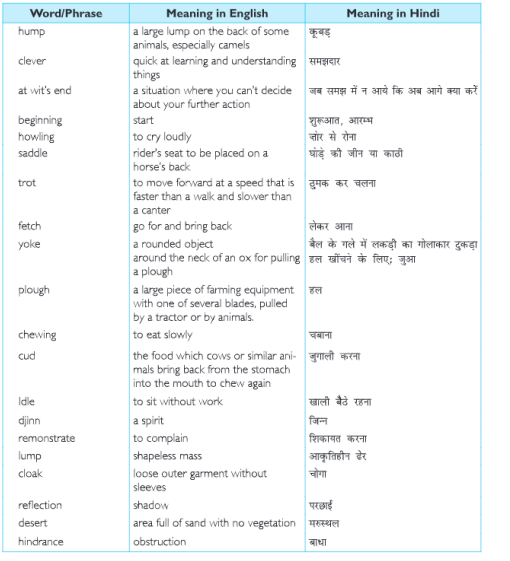
 How The Camel Got His Hump Word Meanings

English part 2

How The Camel Got His Hump Textbook Exercises Comprehension Check 1

  1. What tasks, do you think, were assigned to the dog and the ox?

Answer. The dog was asked to fetch and carry things and the ox was assigned the task of ploughing the land.

  1. Why did the camel live in the middle of the desert?

Answer. The camel lived in the middle of the desert because he did not want to work. He ate sticks, thorns and prickles.

  1. What made the dog, the horse and the ox very angry?

Answer. The dog, the horse and the ox had to do extra work while the camel did not work. This made them very angry.

  1. “How did the Djinn know that horse was clom plaining against the camel?

Answer. The Djinn came to know that the horse was complaining against the camel by the way the horse described the camel. The horse said that there was a thing in the middle of the desert with a long neck and long legs.

KSEEB Class 8 English Reader Solutions For How The Camel Got His Hump 

How The Camel Got His Hump Comprehension Check 2

  1. The camel was looking at his own reflection in the pool. What does it suggest to you about the camel?

Answer. The camel was in love with himself. He admired himself from every angle by looking at his reflection. It is called ‘self-fascination’. He was selfish and could not think beyond himself.

  1. The camel said ‘Humph’ repeatedly. How did it affect him?

Answer. In the beginning by saying ‘Humph’, the camel was able to avoid work. But later he was punished for the same. He got a ‘hump’ on his back and he had to work as well.

  1. What, according to the Djinn, was the use of the hump?

Answer. The hump of the camel had a purpose that was to use the fat stored within it as nourishment during scarcity of food. In this manner, the camel could go without food for three days.

4. He has never yet learnt to behave.” In the light of this, what is the writer’s opinion about the camel?

Answer. The writer feels that the camel has a high oppinion of himself. He does not understand that everybody has to do his/her share of work. Nobody can afford to sit idle. The camel was punished for his irrational behaviour but it seems that he still has not learnt his lesson properly as a camel is, even now, considered a lazy animal.

 How The Camel Got His Hump Exercises (Solved)

Discuss the following topics in groups.

  1. Can this story be factually true?

Answer. No, this story can’t be factually true. I don’t believe that there is a Djinn in charge of all deserts.

  1. What, according to you, is the story about?

Consider the following:

  • How the world began.
  • Why everyone should do his/her share of work seriously.
  • How animals are important to humans.
  • How the camel got his hump.
  1. What did you do over the weekend? Were you generally active or idle? Please check your back before starting to discuss or answer the qusetion.

Answer. I was very active during the last weekend. I arranged my cupboard; mowed the lawn; helped father washing the car, etc. In fact, I can’t sit idle. So, there is no question of getting a hump on my back. Answer may vary from person to person.

  1. There are broadly two categories of workers-those who prefer to do today, what they can do tomorrow, and those who prefer to do tomorrow, what they can do today. Where do you belong?

Answer. I belong to the category of workers who prefer to do today what they can do tomorrow. The work detained is detained for ever.

How The Camel Got His Hump Class 8 KSEEB Questions And Answers 

 How The Camel Got His Hump Additional Questions

Very Short Answer Type Questions

  1. Who were the first helpers of man in his work?

Answer. Animals were the first helpers of man in his work.

  1. Why were the three animals who worked for man asked to work double time?

Answer. They were asked to work double time in order to make up for the Camel’s share.

 How The Camel Got His Hump Short Answer Type Questions

  1. Why did the horse, the dog and the ox hold a panchayat (meeting)? How did the camel react to it?

Answer. The horse, the dog and the ox worked for man, but the camel did nothing. So the three animals were asked to work double-time in order to make up for the camel’s work. This made them angry and they held a panchayat. The camel also came chewing and laughed at them. Saying, “Humph!” he went away.

  1. What happened after the camel was made to work?

Answer. The camel went to the other three and started working. From that day to this, the hump is on his back and he has not been able to cover up for those three days.

  1. How did the camel behave when the other animals had started working for man?

Answer. When the other animals had started working for man, the camel behaved differently. He would do nothing but eat sticks and thorns that grew in the desert. If he was asked to work he just said, “Humph”.

  1. Who was in charge of all deserts? How did he try to convince the camel to work and with what result?

Answer. The Djnn was incharge of all deserts. When he came to know that the camel did no work, he went to him. He told him that the other three animals had to do extra work because of his idleness. But he reply he got was “Humph”.

  1. What was change that came over the camel after he got his hump? Has he learnt to behave?

Answer. After the camel had got his hump, he went to the other three animals and started working. But he has not been able to cover up for those days when he did no work. He has also not learnt to behave.

Explanation of How The Camel Got His Hump KSEEB Class 8 

 How The Camel Got His Hump Long Answer Type Questions

  1. Describe the manner in which the Camel got his hump.

Answer. After listening to the complaints against the camel, the Djinn went to him. He told him that due to his idleness the other three animals had to work extra. But even the Djinn got the same reply “Humph” The Djinn suggested to him that he should work and abstain from saying “Humph” But the Camel again uttered, “Humph”. As soon as he said that, his back puffed up and there was a big hump on his back.

  1. What did the Djinn tell the Camel about his hump and how did he convince him to work?

Answer. The Djinn told the Camel that due to his own laziness and idleness he had brought this ‘humph’ up on his back. For the past three days, the Camel had not worked. Now the Camel was worried. He asked the Djinn how he could work with the humph on his back. The Djinn explained that his humph had a purpose. As he had not worked for the last three days, his humph would help him to work without eating for three days. The Djinn told the camel that it was time for him to join the other three animals in their work.

  1. How did the horse, the dog and the ox try to make the camel to work for man?

Answer. The horse, the dog and the ox had started working for man. But the lazy camel would not. So they went to the camel one by one to make him work. First of all the horse asked him to get up and trot like others, but the camel said “Humph”. Then the dog came with a stick in his mouth and asked the m camel to fetch and carry things like others but once again the camel replied by saying “Humph”. After this, the ox went to the camel with a yoke on his neck. He also asked him to plough like the rest of them but the camel gave the same reply “Humph”

KSEEB Solutions For Class 8 English Chapter 2 The Tsunami

The Tsunami 

Summary In English

A tsunami is a very large and powerful sea wave. It is caused by earthquakes under the sea. These waves are very destructive as they wash away everything that comes in their way. On December 26 2004, atsunami hit Thailand and parts of India such as the Andaman and Nicobar Islands and the Tamil Nadu Coast. Here are some stories of courage and survival.

STORIES FROM THE ANDAMAN AND NICOBAR ISLANDS

1. Ignesious’s wife felt earthquake tremors at 6 a.m. She woke his husband up. The whole family rushed out of the house. When the tremors stopped, they saw the sea rising. While trying to escape the tsunami, Ignesious lost his wife and two children. However, three of his children who came with in were saved.

  1. Sanjeev, a policeman, was able to save himself, his wife and daughter from the waves. But when he tried to rescue the guesthouse cook’s wife, he too was swept away along with her.
  2. Meghna, a thirteen year-old girl, was swept away along with her parents and seventy-seven other people. She spent two days holding on to a wooden door in the sea. She was brought other shore by a wave.
  3. Almas Javed, a ten year-old girl, was celebrating Christmas with her family. She lost her grandfather and father who became the victims of a giant wave. Her mother and aunts too were washed away. Luckily, Almas was able to save herself with the help of a floating log of wood. But she was greatly shocked by the incident.

2. A STORY FROM THAILAND

This is the story of Tilly smith, a ten year old British school girl. She had come to Thailand for Christmas celebrations along with her seven year-old sister and parents, Penny and Colin Smith. She had seen a video of tsunami two weeks before in her class. She knew the signs of a tsunami: slow rise of the sea, foaming, bubbling and formation of whirlpools. She saw the same signs and started screaming at her family to get off the beach. Her parents got confused to see their daughter terribly frightened. Tilly’s family and several other tourists left the beach. Tilly’s family took refuge in the third floor of a hotel. Those who stayed back lost their lives.

3. ANIMAL BEHAVIOUR

Some people believe that the animals can sense the coming of a tsunami. More than 150,000 people lost their lives in the tsunami of 2004 but not many animals were reported dead. It is said that their sixth sense warn them of the danger and they run for life. For example, in Yala National Park, Sri Lanka, no animal carcasses were found after the tsunami. It was reported that three elephants had run away from the beach an hour before the tsunami hit. Similarly, two dogs of a gentleman living on the Coast near Galle refused to go for their daily run on the beach on the day of tsunami and thus, saved their master’s life.


KSEEB Solutions For Class 8 English Chapter 2 The Tsunami


The Tsunami Summary In Hindi

सुनामी एक बहुत ही विशाल और शक्तिशाली लहर होती है। यह समुद्र के नीचे भूकम्पों से पैदा होती है। ये लहरें बहुत ही विनाशकारी होती है, क्योंकि इनके मार्ग में कुछ भी आता है, ये उसे बहा ले जाती है। 26 दिसम्बर 2004 को एक सुनामी ने थाईलैंड तथा भारत के कुछ भागों, जैसे कि अंडमान और निकोबार द्वीपसमूह तथा तमिलनाडु तट को अपनी चपेट में ले लिया था। यहां साहस तथा बचाव से संबंधित कुछ कहानियां दी गई हैं।अंडमान एवं निकोबार द्वीपसमूह की कहानियां

  1. इग्नीशियस की पत्नी को सुबह 6 बजे भूकम्प का आभास हुआ। उसने अपने पति को जगाया, सारा परिवार अपने घर से बाहर भाग आया। जब भूकम्प रूका तो उन्होंने समुद्र को ऊपर उठते देखा। बचाव के प्रयास करते समय इग्नीशियस अपनी पत्नी और दो बच्चों के प्राण गंवा बैठा। परंतु उसके तीन बच्चों की जान बच गई।
  1. संजीव, जांकि पुलिस का एक सिपाही था, लहरों से अपनी अपनी पत्नी तथा पुत्री की जान बचाने में सफल रहा। परंतु जब उसने जॉन की पत्नी बचाने का प्रयास किया, उसे भी लहरें उसके बहा कर ले गई।
  1. तेरह साल की एक लड़की मेघना अपने माता-पिता तथा 77 अन्य लोगों साथ बह गई। उसने समुद्र में लकड़ी के एक दरवाजे को पकड़कर दो दिन बिताये। उसे तट पर पहुँचने वाली एक लहर ने बचा लिया।
  2. दस साल की एक लड़की अल्पास जावेद अपने परिवार के साथ क्रिसमस मना रही थी। वह अपने दादा और पिता को खो बैठी एक विशाल लहर का शिकार हो गए। उसकी मां और मौसियां ( aunts ) भी बह गई। सौभाग्यवश अल्मास  लकड़ी के तैरते हुए लट्ठे की सहायता से अपनी जान बचाने में सफल रही। परंतु इस घटना से उसे गहरा सदमा पहुंचा।

थाइलैंड की कहानी

यह ब्रिटेन की एक दस वर्षीय स्कूली लड़की टिलि स्मिथ की कहानी है। वह अपनी सात वर्षीय बहन और अपने माता-पिता पैनी एवं कोलिन स्मिथ के साथ थाइलैंड के एक बीच की सैरगाह पर क्रिसमिस मनाने आई थी। उसने दो सप्ताह पहले अपनी क्लास में सुनामी का एक वीडियो देखा था। उसे सुनामी आने के संकेतों की जानकारी थी। वे संकेत थे समुद्र ( के पानी ) का ऊपर उठना, झाग बनना, बुलबुले उठना और भंवर चक्रों का बनना। उसने वही संकेत देखे और चिल्ला कर अपने परिवार को बीच से हट जाने के लिए कहा। अपनी बेटी को बुरी तरह डरा देखकर उसके माता पिता घबरा गए। टिली के परिवार तथा कई अन्य पर्यटक बीच छोड़ कर चले गए। टिली के परिवार ने होटल के तीसरे माले पर शरण ली। वे लोग जो वही रह गए अपनी जान गवा बैठे।

पशुओं का व्यवहार

कुछ लोगों का विश्वास है कि पशु सुनामी आने के खतरे को भाँप सकते है। सुनामी के कारण 150,000 से भी अधिक लोग मारे गए, परंतु रिपोर्टों के अनुसार मरने वाले पशुओं की संख्या अधिक नहीं थी। कहा जाता है कि उनकी छठी इन्द्री उन्हें खतरे की चेतावनी दे देती है और वे अपने प्राण बचाने के लिए भाग जाते है। उदाहरण के लिए श्रीलंका के माला नेशनल पार्क के तीन हाथी सुनामी आने से एक घंटा पहले ही बीच से भाग गए थे। इसी प्रकार एक गाला के निकट तट पर रहने वाले एक सज्जन के दो कुत्तों ने सुनामी वाले दिन बीच पर अपनी दैनिक दौड़ के लिए जाने से इन्कार कर दिया था। इस प्रकार उन्होंने अपने तथा अपने मालिक के प्राण बचा लिए।

The Tsunami Hindi Translation Of The Lesson (With Word Meanings)

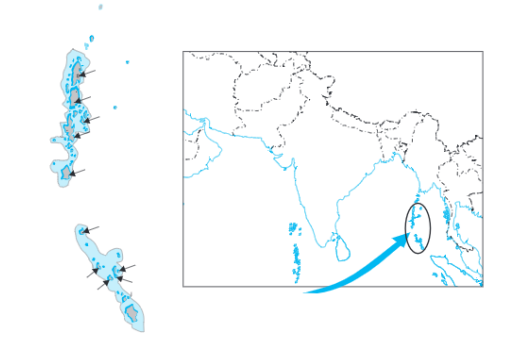
Look at the map of the Andaman and Nicobar Islands given here.


english chapter 1 map

  1. Now read the sentences below. Rewrite the incorrect ones after correcting the mistakes.
  1. Katchall is an island.
  2. It is part of the Andaman group of islands.
  3. Nancowry is an island in the Nicobar group.
  4. Katchall and Nancowry are more than a hundred miles apart. (Hint: the scale of the map is given.)
  5. The Andaman and Nicobar Islands are to the west of India.
  6. The Nicobar Islands are to the north of the Andaman Islands.

Answer.

  1. Correct.
  2. It (Katchall) is a part of the Nicobar group of islands.
  3. Correct.
  4. Katchall and Nancowry are less than a hundred miles apart.
  5. The Andaman and Nicobar Islands are to the south-east of India.
  6. The Nicobar islands are to the south of the Andaman islands.A tsunami is a very large and powerful wave caused by earthquakes under the sea. On 26 December 2004, a tsunami hit Thailand and parts of India such as the Andaman and Nicobar Islands, and the Tamil Nadu Coast. Here are some stories of courage and survival.

Did animals sense that a tsunami was coming? Some stories suggest that they did.

 These stories are all from the Andaman and Nicobar archipelago. Ignesious was the manager of a cooperative society in Katchall. His wife woke him up at 6 a.m. because she felt an earthquake. Ignesious carefully took his television set off its table and put it down on the ground so that it would not fall and break. Then the family rushed out of the house. When the tremors stopped, they saw the sea rising. In the chaos and confusion, two of his children caught hold of the hands of their mother’s father and mother’s brother, and rushed in the opposite direction. He never saw them again. His wife was also swept away. Only the three other children who came with him were saved.

सुनामी एक बहुत ही विष्ठशाल और ष्टाक्तिष्ठशाली लहर होती है जो समुद्र के नीचे भूकम्पों से पैदा होती है। 26 दिसम्बर, 2004 को थाइलैंड और भारत के कुछ भागों जैसे अण्डमान और निकोबार द्वीप समूह तथा तमिलनाडु के समुद्री तटीय भागों को सुनामी का प्रकोप झेलना पड़ा। यहां साहस और अस्तित्व के बचाव की कुछ कहानियां दी गई है। क्या पशुओं को सुनामी के आने का आभास हो गया था? कुछ कहानियों यह सिद्ध हो गया कि उन्हें सुनामी के आने का आभास हो गया था। ये सभी कहानियां अण्डमान तथा निकोबार द्वीप समूह की हैं। इगनीसियस कचल (Katchall) में एक सहकारी समिति का प्रबन्धक (मैनेजर) था। उसकी पत्नी ने उसे प्रातः छः बजे जगा दिया क्यों उसने भूकम्प के झटके महसूस किए थे। इगनीसियस ने सावधानी से टेलीविजन को मेज के ऊपर से उठा कर जमीन पर रख दिया ताकि वह गिरकर टूट न जाए। फिर परिवार तेजी से घर के बाहर भागा। जब कम्पन रुक गई, तब उन्होंने समुद्र को उठते देखा। इस अफरातफरी में उसके दो बच्चे अपने नाना और मामा के हाथ पकड़ कर विपरीत दिशा में भागे। वे उसे दोबारा कभी दिखाई नहीं दिये। उसकी पत्नी भी बह गई। केवल तीन बच्चे जो उसके साथ आए थे, बच गए।

Word Meanings

  • courage bravery, साहस
  • tremor shaking and trembling of earth, कम्पन
  • opposite completely different विपरीत
  • rushed out to move swiftly, तेजी से बाहर भागा
  • chaos complete disorder अफरातफरी
  • swept away washed off, बह गई
  1. Sanjeev was a policeman, serving in the Katchall island of the Nicobar group of Islands. He somehow managed to save himself, his wife and his baby daughter from the waves. But then he heard cries for help from the wife of John, the guesthouse cook. Sanjeev jumped into the water to rescue her, but they were both swept away. Thirteen year-old Meghna was swept away along with her parents and seventy-seven other people. She spent two days floating in the sea, holding on to a wooden door. Eleven times she saw relief helicopters overhead, but they did not see her. She was brought to the shore by a wave, and was found walking on the seashore in a daze.

संजीव पुलिस का सिपाही था जो निकोबार द्वीप समूह के कचल (Katchall) द्वीप में नौकरी करता था। वह किसी प्रकार अपने आप को, अपनी पत्नी को तथा अपनी बच्ची को लहरों से बचाने में सफल रहा। परन्तु तब उसने अतिथिगृह के रसोइए जॉन की पत्नी की चीखें सुनी जो सहायता के लिए चिल्ला रही थी। संजीव उसे बचाने के लिए पानी में कूद पड़ा, परन्तु वे दोनों पानी में बह गए।

तेरह वर्षीय मेघना अपने माता-पिता और 77 अन्य लोगों के साथ पानी में बह गई। वह दो दिन तक लकड़ी का एक दरवाजा पकड़े समुद्र में तैरती रही। उसने ऊपर 11 बार राहत पहुचाने वाले हेलिकाप्टरों को उड़ते देखा, परन्तु उन्होंनें उस बच्ची को नहीं देखा। उसे एक लहर तट पर ले आई और वह स्तब्ध अवस्था में समुद्र तट पर चलते मिली

Word Meanings

  • dazed – stunned, bewildered, चकित, स्तब्ध
  • relief helicopter – helicopter bringing help to
  • people during flood emergencies,
  • rescue save बचाने के लिए

राहत कार्य करने वाला हेलीकाप्टर

  1. Almas Javed was ten years old. She was a student of Carmel Convent in Port Blair where her father had a petrol pump. Her mother Rahila’s home was in Nan covery island. The family had gone there to celebrate Christmas. When the tremors came early in the morning, the family was sleeping. Almas’ father saw the sea water recede. He understood that the water would come rushing back with great force. He woke everyone up and tried to rush them to a safer place.

अल्मास जावेद की आयु दस वर्ष थी। वह पोर्ट ब्लेयर में, जहां उपके पिता का पैट्रोल पम्प था, कर्मिल कानवेंट की छात्रा थीं। उसकी मां Rahila का मायका नैनकाओरि (Nancowry) द्वीप में था। परिवार वहाँ क्रिसमस मनाने गया था। जब प्रातः भूंकप आया, वे सब सो रहे थे। अल्यास के पिता ने समुद्र की लहरो को वापस जाते देखा। वो समझ गये कि पानी ताकत से वापस आएगा। उन्होंने सब को जगाया और सुरक्षित स्थान पर भागने की कोशिश की।

Word Meanings

recede withdraw move back, वापिस जाना

  1. As they ran, her grandfather was hit on the head by something and he fell down. Her father rushed to help him. Then came the first giant wave that swept both of them away.
    Almas’ mother and aunts stood clinging to the leaves of a coconut tree, calling out to her. A wave uprooted the tree, and they too were washed away. Almas saw a log of wood floating. She climbed on to it. Then she fainted. When she woke up, she was in a hospital in Kamorta. From there she was brought to Port Blair. The little girl does not want to talk about the incident with anyone. She is still traumatised.

जब वे दौड़ रहे थे तो उसके नाना के सिर में कोई चीज लगी और वह गिर पड़े। उसके पिता उनकी ( नाना की ) सहायता के लिए दौड़े। उसी समय एक दैत्याकार लहर आई और दोनों को बहा ले गई। अल्मास की मां और मौसियां नारियल के पत्तों को पकड़े खड़ी थीं और उसे पुकार रही थीं। एक लहर ने वृक्ष को उखाड़ दिया और वे भी उसके साथ ही बह गई।
अल्मास ने लकड़ी का एक लट्ठा तैरते देखा। वह उस पर बैठ गई। तब वह बेहोश हो गई। जब उसे होश आया तो वह कमॉटो ( Kamorta) के एक हस्पताल में थी। वहा से उसे पोर्ट ब्लेयर (Port Blair) लाया गया। यह छोटी लड़की किसी से भी इस घटना के विषय में बात नहीं करना चाहती। वह अभी भी सदमे में हैं।

Word Meanings

  • giant huge, दैत्याकार
  • fainted – became unconscious, बेहोष्ठा हो गई
  • traumatised – greatly shocked and distressed,

सदमें में

clinging – hold on tightly, कस के पकड़ना

  1. Tilly Smith (a British school grl ) was able to save many I’ves when the tsunami struck Phuket beach in Thailand. Though she has won a number of awards, her parents have not allowed their daughter to be interviewed on television ana maae into a heroine. Why do you think they too< that decision?
    Now here is a story from Thailand.
    The Smith family from South-East England were celebrating Christmas at a beach resort in souther Thailand. Tilly Smith was a ten-year-old schoolgirl; her sister was seven years old. Their parents were Penny and Colin Smith. It was 26 December 2004. Deadly tsunami waves were already on their way. They had been triggered by a massive earthquake off northern Sumatra earlier that morning.

ब्रिटेन की एक स्कूली लड़की टिलि स्मिथ ने थाईलैंड के फुकेट सागर तट पर आई सुनामी में अनेक लोगों की जान बचाई थी। यद्यपि उसने बहुत से इनाम जीते हैं तो भी उसके माता-पिता ने उसे नायिकाओं के समान टेलीविजन पर साक्षात्कार की अनुमति नहीं दी है। आपके विचार में उन्होंने ऐसा निर्णय क्यों लिया?

  1. “The water was swelling and kept coming in,” Penny Smith remembered. “The beach was getting smaller and smaller. I didn’t know what was happening.” But Tilly Smith sensed that something was wrong. Her mind kept going back to a geography lesson she had taken in England just two weeks before she flew out to Thailand with her family. Tilly saw the sea slowly rise, and start to foam, bubble and form whirlpools. She remembered that she had seen this in class in a video of a tsunami that had hit the Hawaiian islands in 1946. Her geography teacher had shown her class the video, and told them that tsunamis can be caused by earthquakes, volcanoes and landslides.

“समुद्र का पानी उफान पर था और निरन्तर अन्दर प्रवेश कर रहा था । ” पैनि स्मिथ को याद था । “सागर तट छोटा होता जा रहा था। मेरी समझ में नहीं आया कि क्या हो रहा है।” परन्तु टिलि स्मिथ को आभास हो गया कि कुछ गड़बड़ अवश्य है। उसे अपने परिवार के साथ थाईलैंड के लिए उड़ान भरने से दो सप्ताह पहले इंग्लैड़ में पढ़े गए भूगोल के पाठ की याद आईं। टिलि ने समुद्र के पानी को धीरे-धीरे चढ़ते झाग बनाते, बुलबुले उठाते और भंवर बनाते देखा। उसे याद आया कि उसने 1946 में (Hawaiian) हवाई द्वीप समूह में आए सुनामी का ऐसा ही दृश्य अपनी कक्षा में वीडियों में देखा था। उनके भूगोल अध्यापक ने क्लास को वीडियो दिखाया था और उन्हें बताया था कि सुनामी लहरें भूकम्प, ज्वालामुखी और भूस्खलन के कारण उठती है।

Word Meanings

  • sensed became aware of महसूस किया
  • landslide – a slide of a large mass of dirt and rock
  • down a mountain or cliff, भूस्खलन
  • bubble boil foam, उबलना
  • hysterical caused by hysteria उन्मादी
  1. Tilly started to scream at her family to get off the beach. “She talked about an earthquake under the sea. She got more and more hysterical,” said her mother Penny. “I didn’t know what a tsunami was. But seeing my daughter so frightened, I thought something serious must be going on.” Tilly’s parents took her and her sister away from the beach, to the swimming pool at the hotel. A number of other tourists also left the beach with them. “Then it was as if the entire sea had come out after them. I was screaming, ‘Run!’ The family took refuge in the third floor of the hotel. The building withstood the surge of three tsunami waves. If they had stayed on the beach, they would not have been alive. The Smiths later met other tourists who has lost entire families. Thanks to Tilly and her geography lesson, they had been forewarned. Tilly went back to her school in England and told her classmates her terrifying tale.

टिलि ने चिल्लाते हुए अपने परिवार को सागर तट से दूर भागने को कहा। “उसने समुद्र के नीचे आए भूकम्प के बारे में बताया। वह और अधिक उन्मादी होती जा रही थी। ” उसका मां पैनि ने बताया, “मैं सुनामी के बारे में नहीं जानती थी। परन्तु अपनी पुत्री को इतना भयभीत देखकर मैने सोचा कि कोई गम्भीर घटना घटने वाली है । ” टिलि के माता-पिता उसे और उसकी बहन को बीच (तट) से दूर होटल में स्विमिंग पूल पर ले गए। उनके साथ ही अनेक अन्य सैलानी भी सागर तट से चले गए। “फिर ऐसा लगा मानों पूरा सागर उनके पीछे तट से बाहर आ गया हो।” मैं चीख रही थी, “भागो। ” परिवार ने होटल की तीसरी मंजिल पर शरण ली। होटल का भवन तीन सुनाम

लहरों का संवेग सहन कर गया। यदि वे सागर तट पर रुके रहते तो वे जीवित न बचते। स्मिथ परिवार बाद में अन्य सैलानियों से मिला जिनके परिवार के परिवार समाप्त हो गए थे। टिलि और उसके भूगोल के पाठ का धन्यवाद, उन्हें पहले ही चेतावनी मिल गई थी। जब टिलि वापिस इंग्लैंड में अपने स्कूल गई तो उसने अपने सहपाठियों को अपनी भयानक आप बीती सुनाई।

Word Meanings

  • refuge shelter, protection from danger, आश्रय
  • terrifying – frightening, भयानक
  • surge force, momentum बल, संवेग
  • withstood endured without collapsing, सहन

किया

Look carefully at the picture of the boy and his dog, and try to describe the things that you see, using just words and phrases. Either the teacher or one of the students can write down the words and phrases on the blackboard. This is how you can start-
calm, blue sea…..ruined huts.

  1. Before the giant waves slammed into the coast in India and Sri Lanka, wild and domestic animals seemed to know what was about to happen. They fled to safety. According to eyewitness accounts, elephants screamed and ran for higher ground; dogs refused to go outdoors; flamingoes abandoned their low-lying breeding areas; and zoo animals rushed into their shelters and could not be enticed to come back out.

लड़के और उसके कुत्ते की तस्वीर को ध्यान से देखो और जो चीज़ आप देखते हैं उन्हें केवल शब्द समूहों में वर्णन करों| अध्यापक अथवा विद्यार्थियों में से कोई एक शब्द और शब्द समूहों को ब्लैकबोर्ड पर लिखा सकता है। आप इस प्रकार आरम्भ कर सकते हैं-
शान्ति….. नीला सागर…. नष्ट हुई झोंपड़ियाँ…..

विशाल लहरों के भारत तथा श्रीलंका के सागर तटों से धमाके के साथ टकराने से पहले ऐसा लगता है कि जंगली और पालतू पशुओं को पता चल गया था कि क्या होने वाला है। वे सुरक्षित स्थानों पर भाग गए। प्रत्यक्ष साक्षियों (चश्मदीदा गवाहों) के विवरण के अनुसार, हाथी चिंघाड़ने लगे तथा ऊंचे स्थानों की ओर भागने लगे कुत्ते घरों से बाहर जाने में आनाकानी करने लगे। राजहंस पक्षी प्रजनन के निचले स्थानों से चले गए। चिड़ियाघर के पशु तेजी से अपने शरण स्थानों पर चले गए और उन्हें बाहर निकलने के लिए बहलाया फुसलाया नहीं जा सका।

Word meanings

  • slammed hit forcefully, जोर से टकराई
  • abandoned – gave up, ts feat
  • flamingo long-necked bird, राजहंस पक्षी
  • breeding – producing of young by animals,

प्रजनन

  1. Many people believe that animals possess a sixth sense and know when the earth is going to shake. Some experts believe that animals’ more acute hearing helps them to hear or feel the earth’s vibration. They can sense an approaching disaster long before humans realise what’s going on. We cannot be sure whether animals have a sixth sense or not. But the fact is that the giant waves that rolled through the Indian Ocean killed more than 150,000 people in a dozen countries; but not many animals have been reported dead.

बहुत से लोगों का विश्वास है कि पशुओं में छठी इन्द्री (छठी हिस) होती है और वे जानते हैं कि पृथ्वी हिलने वाली है (भूकम्प) आने वाला है)। कुछ विशेषज्ञों का मत है कि पशुओं की सुनने की तीव्र शाक्ति पृथ्वी के कम्पन को सुनने या महसूस करने में उनकी सहायता करती है। उन्हें मनुष्यों से बहुत पहले विनाश का आभास हो जाता है। हम विश्वास से नहीं कह सकते कि पशुओं में छठी इन्द्री होती है अथवा नहीं। परन्तु सत्य है कि हिन्द महासागर में उठने वाली विशाल लहरों ने दर्जन भर देशों में 1,50,000 लोगों को मौत की नींद सुला दिया, परन्तु पशुओं के अधिक संख्या में मरने की जानकारी नहीं है।

Word Meanings

  • acute intense, तीव्र
  • disaster – an event resulting in great loss and
  • misfortune, विनाश
  1. . Along India’s Cuddalore coast, where thousands of people perished, buffaloes, goats and dogs were found unharmed. The Yala National Park in Sri Lanka is home to a variety of animals including elephants, leopards and 130 species of birds. Sixty visitors were washed away from the Patanangala beach inside the park; but no animal carcasses were found, except for two water buffaloes. About an hour before the tsunami hit, people at Yala National Park had observed three elephants running away from the Patanangala beach.

A Sri Lankan gentleman who lives on the coast near Galle said his two dogs would not go for their  daily run on the beach. “They are usually excited to go on this outing,” he said. But on that day they refused to go, and most probably saved his life.

भारत के कडलोर (Cuddalore ) तटीय भाग में जहां हज़ारों लोग मारे गए, भैंसों, बकरियों और कुत्तों की कोई हानि नहीं पहुंची। श्रीलंका में याला नैशनल याला नैशनल पार्क (Yala National Park) हाथियों, तेंदुओं सहित पक्षियों की 130 प्रजातियों का आश्रय स्थान है। पार्क के अन्दर पातंगला (Patangala beach) तट पर 60 पर्यटक बह गए परन्तु दो समद्री भैंसों के शवों के अतिरिक्त अन्य किसी पशु का शव नहीं मिला। सुनामी लहरों के सागर तट से टकराने से एक घंटा पहले याला नैशनल पार्क के लोगों ने तीन हाथियों को पातंगला बीच से दूर भागते देखा था।

गाले के निकट सागर तट पर रहने वाले श्रीलंका के एक भद्र पुरुष ने बताया कि उसके दोनों कुत्तं रोज़ की तरह तट पर दौड़ने के लिए नहीं गए। उसने कहा, “प्रायः वे (कुत्ते) बाहर जाने के लिए उत्तेजित रहते हैं। परन्तु उस दिन उन्होनें बाहर जाने से मना कर दिया और सम्भवतः इसी कारण उसकी अपनी जान बच गई। “

Word Meanings

  • excited thrilled, उत्तेजित
  • perished died, suffered destruction, मर गए,
  • नज्ट हो गए
  • refused rejected, मना कर दिया


The Tsunami D. Textbook Exercises (Solved)

Comprehension Check—1

Say whether the following are true or false.

  1. Ignesious lost his wife, two children, his father-in-law, and his brother-in-law in the tsunami.
  2. Sanjeev made it to safety after the tsunami.
  3. Meghna was saved by a relief helicopter.
  4. Almas’s father realised that a tsunami was going to hit the island.
  5. Her mother and aunts were washed away with the coconut tree that they were holding on to.

Answer. 1. True 2. False 3. False 4. True 5. True

The Tsunami Comprehension Check-2

Answer the following in a phrase or sentence.

  1. Why did Tilly’s family come to Thailand?

Answer. Tilly’s family came to Thailand to celeberate Christmas.

  1. What were the warning signs that both Tilly and her mother saw?

Answer. Both Tilly and her mother saw that the water was swelling and kept coming in and the beach was getting smaller and smaller.

  1. Do you think Tilly’s mother was alarmed by them (the warning signs)?

Answer. No, she wasn’t alarmed by them as she did not know what was happening.

  1. Where had Tilly seen the sea behaving in the same strange fashion?

Answer. Tilly had seen the sea behaving in the same strange fashion when her teacher in one of the lessons in school showed a video of a tsunami that had hit the Hawaiian islands in 1946.

  1. Where did the Smith family and the others on the beach go to escape from the tsunami?

Answer. The Smith family and the others on the beach went to the swimming pool at the hotel to escape from the tsunami.

  1. How do you think Tilly’s geography teacher felt when he heard about what Tilly had done in Phuket?

Answer. I think her geography teacher must have felt proud of Tilly.

The Tsunami Comprehension Check-3

Answer using a phrase or a sentence.

  1. In the tsunami 150,000 people died. How many animals died?

Answer. Not many animals died in the tsunami.

  1. How many people and animals died in Yala National Park?

Answer. Sixty people died whereas only two water buffaloes died in the Yala National Park.

  1. What do people say about the elephants of Yala National Park?

Answer. People say that three elephants of Yala National Park ran for higher ground about an hour before the tsunami hit.

  1. What did the dogs in Galle do?

Answer. The dogs in Galle refused to go for their daily run on the beach.

The Tsunami Working With The Text

Discuss the following questions in class. Then write your own answers.

  1. When he felt the earthquake, do you think Ignesious immediately worried about a tsunami? Give reasons for your answer. Which sentence in the text tells you that the Ignesious family did not have any time to discuss and plan their course of action after the tsunami struck?

Answer. No, Ignesious did not worry about a tsunami when he felt the earthquake. Rather he was worried about his television. He took it off the table and put it on the ground lest it should break. The sentence that tells us that Ignesious did not have any time for discussion is In the chaos and confusion, two of his children caught hold of the hands of their mother’s father and mother’s brother, and rushed in the opposite direction.”

  1. Which words in the list below describe Sanjeev, in your opinion?

[Look up the dictionary for words that you are not sure of.

brave

cheerful

heroic

brash

heartless

humorous

ambitious

selfless

careless

Answer. Sanjeev was brave, heroic and selfless.

Use words from the list to complete the three sentences below

  1. I don’t know if Sanjeev was cheerful_____ or____
  2. I think that he was very brave______ or____
  3. Sanjeev was not heartless______ or_____

Answer. (1) ambitious, humorous (2) heroic, selfless (3)bresh,careless

  1. How are Meghna’s and Almas’s stories similar?

Answer. Meghna was swept away along with her parents. She spent two days floating in the sea, holding on to a wooden door. A wave brought her to the shore. Similarly, Almas was also washed away. She climbed on a log of wood and fainted. She woke up to find herself in a hospital. Thus, both escaped death.

  1. What are the different ways in which Tilly’s parents could have reacted to her behaviour? What would you have done if you were in their place?

Answer. Her parents could have thought that Tilly had lost her wits. They could have also thought that Tilly was having a fit of hysteria. If I had no knowledge about tsunamis, I would also have reacted in the same way.

  1. If Tilly’s award was to be shared, who do you think she should share it with her parents or her geography teacher?

Answer. I think she should decidedly share it with her geography teacher.

  1. What are the two different ideas about why so few animals were killed in the tsunami? Which idea do you find more believable?

Answer. Firstly, many people believe that animals have a sixth sense. They know when the earth is going to shake. Secondly, some experts hold the view that animals’ acute hearing power helps them to hear or feel the earth’s vibation. The second idea is more believable.

The Tsunami Working With Language

1. Go through Part-I carefully, and make a list of as many words as you can find that indicate movement of different kinds. (There is one word that occurs repeatedly-count how many times!) Put them into three categories.

  • fast movement
  • slow movement
  • neither slow nor fast

Can you explain why there are many words in one column and not in the others?

Note: Do it with the help of your teacher.

Fill in the blanks in the sentences below (the verbs given in brackets will give you a clue).

  1. The earth trembled, but not many people felt the_____ (tremble).
  2. When the zoo was flooded, there was a lot of_____ and many animals escaped into the countryside. (confuse)
  3. We heard with_____ _in the lion had recaptured. (relieve).
  4. The Zookeeper was stuck in a tree and his______ was filmed by the TV crew. (rescue).
  5. There was much_______ in the village when the snake chamer came visiting. (excite)

Answer. (1) trembling (2) confusion (3) relief (iv) rescue (4) excitement

3 Study the sentences in the columns A and B.

English chapter 2 table

Compare the sentences in A to the ones in B. Who is the ‘doer’ of the action in every case? Is the ‘doer’ mentioned in A, or in B? The doer is mentioned in column B. Notice the verbs in A ‘was swept away’, ‘was hit’, ‘were washed away’, ‘were found’. They are in the passive form. The sentences are in the Passive Voice. In these sentences, the focus is not on the person who does the action. In B, the ‘doer of the action is named. The verbs are in the active form. The sentences are in the Active Voice. Say whether the following sentences are in the Active or the Passive voice. Write A or P after each sentence as shown in the first sentence.

  1. Someone stole my bicycle. A…..
  2. The tyres were deflated by the traffic police…..
  3. I found it last night in a ditch near my house.
  4. It had been thrown there…..
  5. My father gave it to the mechanic….
  6. The mechanic repaired it for me…..

Answer. (i) A (ii) P (iii) A (iv) P (v) A (vi) A

The Tsunami Speaking And Writing

  1. Suppose you are one of the volunteers who went to the Andaman and Nicobar Islands for relief work after the tsunami. You work in the relief camps, distributing food, water and medicines among the victims. You listen to the various stories of bravery of ordinary people even as they fight against odds to bring about some semblance of normalcy in their lives. You admire their grit and determination. Write a diary entry.

You may start in this way. 31 December, 2004 The killer tsunami struck these islands five days ago. But the victims are being brought in even now. Each  one has a story to tell. 31 December, 2004 The killer tsunami struck these islands five days ago. But the victims are being brought in even now. Each one has a story to tell. A thirteen year old boy told me how he saved seven lives. An old lady and her granddaughter were saved by a boatman. People tell stories how they lost their loved ones when the huge waves came crashing down. Some lost their parents, some siblings and some other, their wives and husbands. Many people have lost all their family members. Rescue operations are still underway and every day survivors are being found stranded on different islands. The survivors are struggling hard to get back to life. I am deeply touched by their grit and determination to live.

  1. The story tells how a little girl saved the lives of many tourists when a tsunami struck the beach, thanks to the geography lesson that she had learnt at school. She remembered the visuals of a tsunami and warned her parents.

Do you remember any incident when something that you learnt in the classroom helped you in some way outside the classroom? Write your experiences in a paragraph of about 90-100 words or narrate it to the whole class like
an anecdote.

Answer. Last Monday I was coming back home from school. It was very hot. I saw an old man walking on the road. He seemed to be a simple villager. Suddenly his nose stared bleeding. He was puzzled what to do. I had learnt in my classroom how to deal with a bleeding nose. I got hold of his hand and took him to a tap. I put his head under it and started the supply of the water. Within five minutes his bleeding stopped. He thanked me and went his way.

The Tsunami  Extract Based Questions

Read the extracts given below and answer the questions that follow.

(1) Ignesious was the manager of a cooperative society in Katchall. His wife woke him up at 6 a.m.

because she felt an earthquake. Ignesious carefully took his television set off its table and put it down on the ground so that it would not fall and break. Then the family rushed out of the house.

  1. What was Ignesious?
  2. Who woke Ignesious up and when?
  3. Why did his wife wake Ignesious up?
  4. What did Ignesious do then and why?
  5. What did the family do?

Answer.

  1. Ignesious was the manager of a cooperative society in Katchall.
  2. His wife woke him up at 6 a.m.
  3. His wife woke him up because she felt an earthquake.
  4. Ignesious took his television set off its table and put it down on the ground lest it should fall and break.
  5. The family rushed out of the house.

(2) When the tremors stopped, they saw the sea rising. In the chaos and confusion, two of his children caught hold of the hands of their mother’s father and mother’s brother, and rushed in the opposite direction. He never saw them again. His wife was also swept away. Only the three other children who came with him were saved.

  1. What did they see after the tremors had stopped?
  2. What did the two children do in the chaos and confusion?
  3. Did the children with their mother’s father and mother’s brother survive the tsunami?
  4. What happeed to his (Ignesious’s) wife?
  5. What happened to his three other children who came with him?

Answer.

  1. They saw the sea rising after the tremors had stopped.
  2. In the chaos and confusion, the two children caught hold of the hands of their mother’s father and mother’s brother, and rushed in the opposite direction.
  3. (No, they did not survive the tsunami as Ignesious never saw them again.
  4. His wife was also swept away.
  5. His three other children who came with him were saved.

(3) Thirteen-year old Meghna was swept away along with her parents and seventy-seven other people. She spent two days floating in the sea, holding on to a wooden door. Eleven times she saw relief helicopters overhead, but they did not see her. She was brought to the shore by a wave, and was found walking on the seashore in a daze.

  1. How old was Meghna?
  2. Who was Meghna swept away along with?
  3. How did she spend two days in the sea?
  4. How many times did she see relief helicopters overhead?
  5. What brought her to the shore?

Answer.

  1. Meghna was thirteen years old.
  2. Meghna was swept away along with her parents and seventy seven other people.
  3. She spent two days floating in the sea, holding on to a wooden door.
  4. Eleven times she saw relief helicopters overhead.
  5. A wave brought her to the shore.

(4) Tilly’s parents took her and her sister away from the beach, to the swimmig pool at the hotel. A number of other tourists also left the beach with them. “Then it was as if the entire sea had come out after them. I was screaming, ‘Run!’.
The family took refuge in the third floor of the hotel. The building withstood the surge of three tsunami waves. If they had stayed on the beach, they would not have been alive.

  1. Where did Tilly’s parents take her and her sister?
  2. Who left the beach with them?
  3. How did the sea behave after that?
  4. Where did the family take refuge?
  5. What did the hotel building withstand?

Answer.

  1. Tilly’s parents took her and her sister to the swimming pool at the hotel.
  2. A number of other tourists also left the beach with them.
  3. it was as if the entire sea had come out after them.
  4. The family took refuge in the third floor of the hotel.
  5. The hotel building withstood the surge of three tsunami waves.

The Tsunami Additional Questions

Very Short Answer Type Questions

  1. What causes a tsunami?

Answer. A tsunami is caused by earthquakes under the sea.

  1. Why did Ignesious’s wife wake him up?

Answer. Ignesious’s wife woke him up because she felt earthquake tremors.

  1. What saved Almas Javed?

Answer. A floating log of wood saved Almas Javed.

  1. Who was Tilly Smith?

Answer. Tilly Smith was a ten year old school girl.

The Tsunami Short Answer Type Questions

  1. Who was Sanjeev? How did he prove to be both lucky and unlucky?

Answer. Sanjeev was a policeman who was able to save himself, his wife and daughter from the deadly waves. But when he tried to rescue the guesthouse cook’s wife, he too was swept away with her by the deadly waves. Thus he proved to be lucky and unlucky, at the same time.

  1. How did Meghna get caught in the waves? How was she saved?

Answer. Meghna was a thirteen year old girl. She was swept away by the waves along with her parents and seventy seven other people. She spent two days holding on to a wooden door in the sea. She was brought back to the shore by a wave and was found walking on the shore, dazed.

The Tsunami Long Answer Type Questions

  1. Who was Tilly Smith? How did she save her family from disaster of the tsunami waves?

Answer. Tilly Smith was a ten year old British school girl. She had come to a beach resort in Thailand to celebrate Christmas with her family. She had seen a video of tsunami two weeks before in her class room. She knew the signs of tsunami. She saw the same signs and started screaming at her family to get off the beach. Her parents got confused to see their daughter terribly frightened. Therefore, Tilly’s family and several other tourists left the beach. Tilly’s family took refuge in the third floor of a hotel. They managed to survive but those who stayed back lost their lives.

  1. What light does the lesson throw on animal behaviour during the tsunami?

Answer. Some people believe that the animals can sense the coming of a tsunami. Some facts suggest that they can. During the tsunami of 2004, more than 150,000 people lost their lives, but not many animals were reported dead. It is said that their sixth sense warn them of the danger and they run for life. For example, in Yala National Park, Sri Lanka, three elephants had run away from the beach an hour before the tsunami hit. Similarly two dogs of a gentleman living on the coast near Galle saved their master’s life by refusing to go for their daily run on the beach on the day of tsunami.

The Tsunami Summary In English

A city looks different when we look at it from ten thousand feet above the ground. While we are in the thick of it, it looks unplanned and without a style. But on seeing it from above the ground, it looks well planned and well-designed.

The poet sees his city from a jet plane in the sky. When his jet sprang into the sky, he came to understand why the city had developed the way it had developed. It means that it had developed according to a plan.

The poet wanted to know another thing. It was why the cities were near rivers why the valleys were populated. This became clear to him when his jet reached ten thousand feet above the ground. It supported the logic of geography that land and water attracted man.

The concluding stanza conveys the theme of the poem. When the poet reached six miles high in his jet, he found that the earth was round. It had more water (sea) than land. But he failed to understand why men on this beautiful earth hated and killed one another.

The Tsunami Summary In Hindi

जब हम एक शहर को पृथ्वी से दस हजार फुट की ऊंचाई से देखते हैं तो यह भिन्न दिखाई देता है। जब हम शहर के बीच होते हैं तो यह बिना किसी योजना एवं शैली से निर्मित प्रतीत होता है, परन्तु पृथ्वी से ऊंचाई पर देखने से यह सुनियोजित और नमूनाबद्ध दिखाई देता है।

कवि अपने शहर को ऊपर जेट हवाई जहाज से देखता है। जब जैट आकाश में उड़ा तो उसकी समझ में आया कि जिस ढंग से शहर विकसित हुआ है उस ढंग से क्यों हुआ। इसका अर्थ यह हुआ कि शहर योजना के अनुसार ही विकसित हुआ।  कवि एक और बात जानना चहाता था। वह थी कि शहर नदियों के निकट क्यों हैं और घाटियों में आबादी क्यों है। यह उसकी समझ में तब आया जब उसका जहाज पृथ्वी से दस हज़ार फुट ऊंचाई पर पहुंचा। इससे भूगोल के उस तर्क की पुष्टी हुई कि मानव भूमि और पानी की ओर आकर्षित हुआ।

अन्तिम छन्द कविता का सार व्यक्त करता है। जब कवि जैट में छः मील की ऊंचाई पर पहुंचा, तो उसे पता चला कि पृथ्वी गोल है। इस पर भूमि की अपेक्षा पानी अधिक है। परन्तु उसकी समझ में यह नहीं आया कि इस सुन्दर पृथ्वी पर लोग एक-दूसरे से घृणा क्यों करते है और क्यों एक-दूसरे को मार डालते हैं।

The Tsunami Hindi translation Of The Lesson (With Word Meanings)

  1. When the jet sprang into the sky, it was clear why the city had developed the way it had, seeing it scaled six inches to the mile. There seemed an inevitability about what on ground had looked haphazard, unplanned and without style When the jet sprang into the sky.

1. जब जेट (हवाई जहाज) आकाश में ऊपर उठा तो यह स्पष्ट हो गया कि शहर का विस्तार इस तरीके क्यों हुआ। इसका पैमाना एक मील के लिए छ: इंच (6 inch = | mile) ही दिखाई पड़ता था। अर्थात् शहर के छोटे रूप को ऐसा लगा कि धरती पर दिखाई देने वाले शहर के तथा अनियोजित विस्तार को रोका नहीं जा सकता था। जब जहाज आकाश में ऊपर पहुंचा तब जा कर इस बात का आभास हुआ।

Word Meanings

sprang moved up, took off, ऊपर उठा

inevitability – state of being unavoidable, fat

बात को टाला या रोका न जा सकना

Haphazard -without any plan, अव्यवस्थित

   2. When the jet reached ten thousand feet, it was clear why the country had cities where the rivers ran and why the valleys were populated. The logic of geography- that land and water attracted man- was clearly delineated When the jet reached ten thousand feet.

2. जब जेट दस हजार फुट की ऊंचाई पर पहुंचा तो यह स्पष्ट हो गया कि देश में शहर नदियों के साथ-साथ क्यों बसे है तथा लोगों ने घाटियों में बस्तियां क्यों बसाई । कवि को भूगोल का यह तर्क स्पष्ट रूप से समझ में आ गया कि मानव को धरती (स्थल) और जल ने अपनी ओर आकर्षित किया। यह जेट के दस हजार फुट ऊपर जाने पर पता चली।

Word Meanings

populated full of inhabitants, आबाद थी

|delineated defined, स्पष्ट हो गया

3. When the jet rose six miles high, it was clear the earth was round and that it had more sea than land. But it was difficult to understand that the men on the earth found causes to hate each other, to build walls across cities and to kill. From that height, it was not clear why.

3. जब जेट छः मील की ऊंचाई पर पहुंचा। तो कवि यह बात समझ गया कि धरती गोल है। और इस पर स्थल की अपेक्षा समुद्र (जल) अधिक है। पर उसके लिए यह समझ पाना कठिन हो गया कि धरती पर मनुष्य किस कारण एक-दूसरे से नफरत (घृणा) करते है। शहरों के बीच दीवारे बनाते हैं और एक दूसरे की हत्या करते है। इतनी ऊंचाई से यह सब कुछ स्पष्ट नहीं था।

Word Meanings

rose went up, ऊपर गया

build walls (here) create barriers to separate

people, दीवारें खड़ी करीं l

The Tsunami Textbook Exercises (Solved)

WORKING WITH THE POEM

  1. Find three or four phrases in stanzas one and two which are likely to occur in a geography lesson.

Answer.The phrases are:

  1. scaled six inches to the mile
  2. the valleys were populated
  3. land and water attracted man
  4. the country had cities where the rivers ran2.  Seen from the window of an aieroplane, the city appears1.  as haphazard as on ground.
    2. as neat as a map
    3.as developed as necessary.

        Mark the right answer.

Answer. (2) as neat as a map.

  3. Which of the following statements are examples of “the logic of       geography”?

  1.  There are cities where there are rivers.
  2. Cities appear as they are not from six miles above the ground.
  3. It is easy to understand why valleys are populated.
  4. It is difficult to understand why humans hate and kill one another.
  5. The earth is round, and it has more sea than land.

Answer.

  1. There are cities where there are rivers.
  2. It is easy to understand why valleys are populated.
  3. The earth is round, and it has more sea than land.

The Tsunami Mention two things that are

  1. clear from the height.
  2. not clear from the height.

Answer.

(1) It is clear from the height that

(a) valleys are populated

(b) the earth is round

(2) It is not clear from the height why humans

(a) build walls across the cities.

(b) hate and kill one another.

The Tsunami Extract Based Questions

Read the stanzas given below and answer the questions that follow.

(1) When the jet reached ten thousand feet, it was clear why the country had cities where the rivers ran and why the valleys were populated. The logic of geography- that land and water attracted man- was clearly delineated When the jet reached ten thousand feet.

(1) Where are the cities located?

Answer. The cities are located near the rivers.

(2) Why are the valleys populated?

Answer. The valleys were populated because of the availability of land and water there.

(3) What is the logic of geography?

Answer. The logic of geography is that land and water attracted man.

(4) When could the poet understand all this?

Answer. The poet could understand all this when he looked down from a height of ten thousand feet above the ground.

(5) Write the rhyming words from the stanza.

Answer. ran – man; populated – delineated

(2) When the jet rose six miles highit was clear the earth was round and that it had more sea than land. But it was difficult to understand that the men on the earth found causes to hate each other, to build walls across cities and to kill. From that height, it was not clear why.

(1) At what height is the jet from the ground?

Answer. The jet is at a height of six miles from the ground.

(2) What becomes clear to the poet?

Answer. It becomes clear to the poet that the earth is round and it has more sea than land.

(3) Who hate and kill one another?

Answer. Men hate and kill one another.

(4) Does the poet know the reason behind it?

Answer. No, the poet fails to understand the reason behind it.

(5) Write the words that rhyme together.

Answer. Land-understand; high-why; round-found.

The Tsunami Additional Questions

Very Short Answer Type Question

  1. From where did the poet have a look on the earth?

Answer. The poet had a look on the earth from a jet in the sky.

  1. What seemed inevitable to the poet?

Answer. The unplanned development of the cities looked inevitable to the poet.

  1. What is the shape of the earth?

Answer. The shape of the earth is round.

  1. Which areas of the earth are generally populated?

Answer. The areas of the earth where land and water are easily available are generally populated.

The Tsunami Short Answer Type Questions

  1. What did the poet learn about the cities of the country from a height of ten thousand feet?

Answer. From a height of ten thousand feet, the poet learnt the fact that land and water attracted man. That is why the cities are located near rivers and the valleys are populated. Valleys and cities near rivers have easy access to fertile land and huge amounts of water..

  1. In what way a city seen from the ground is different from a city seen from above?

Answer. A city when seen from the ground look haphazard, unplanned and without any structure and style. However when one looks at a city from above the ground, one can see that it was made according to a particular plan. When looked from above the cities look properly designed.

The Tsunami Long Answer Type Questions

Give in brief the main idea of the poem.

Answer. Our earth is very beautiful. It is round in shape. The fact becomes clear when seen from the height. The earth has neatly planned cities where rivers run. The valleys are populated. There is more water than land on earth. Everything about the earth makes perfect sense. There is a reason why cities are located near rivers and valleys with fertile lands are populated. However what does not make sense is the hatred and cruelty of man towards his fellow beings. Humans are not satisfied. They build walls across the cities. They hate and kill each other. The poet wants to stress upon the need to live happily and peacefully.

KSEEB Solutions For Class 8 Geography Chapter 5 Industries

KSEEB Solutions for Class 8 Geography Chapter 5 Industries Textbook Questions

Question 1. Answer the following questions:

1. What is meant by the term ‘industry’?

Answer. The term ’industry’ means the economic activity related to producing goods, extracting minerals and providing services.

2. Which are the main factors which influence the location of an industry?

Answer. The main factors on which the location of an industry depends are:

  1. Availability of raw material;
  2. Land
  3. Water
  4. Transportation;
  5. Labor
  6. Electricity
  7. Capital
  8. Market

3. Which industry is often referred to as the backbone of modern industry and why?

Answer. Iron and steel industry is often referred to as :he backbone of modem industry. The reasons are:

  1. It provides base for many industries.
  2. It lays the foundation for the rapid development of the other industries like automobiles, aircrafts, etc. which helps in the economic development of the country.

4. Why cotton textile industry rapidly expanded in Mumbai?

Answer. Cotton textile industry rapidly expanded in Mumbai due to the following reasons:

  1. Its humid climate is favorable for cotton growth,
  2. Facilities of Mumbai as a port for importing machinery,
  3. Availability of raw material,
  4. Availability of skilled labor.

KSEEB Solutions For Class 8 Geography Chapter 5 Industries

5. What are the similarities between information technology industry in Bengaluru and California?

Answer.

  1. Both are international centers of information technology.
  2. Skilled work force is available.
  3. Good climate.
  4. Both are connected with major roads and air ports.

Question 2. Tick the correct answer:

1. Silicon valley is located in:

  1. Bengaluru
  2. California
  3.  Ahmedabad

Answer. 2. California

2. Which one of the following industries is known as sunrise industry?

  1.  Iron and Steel Industry
  2. Cotton textile
  3.  Information Technology

Answer. 3. Information Technology

3. Which one of the following is a natural fibre?

  1. Nylon
  2. Jute
  3. Acryclic

Answer. Jute

Class 8 Geography KSEEB Industries Notes 

Question 3. Distinguish between the following.
1.  Agro- based and Mineral-based Industries.

geography industries

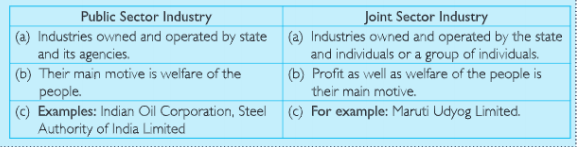
2. .Public Sector Industry and sector industry.
geography industries 1

Question 4. Give two examples of the following in the space provided.
1. Raw Materials:______ and___ .
2. End product: and_____ and ____
3. Tertiary Activities:_____ and _____
4. Agro-based Industries:____ and ____
5. Cottage Industries:____ and _____
6. Co-operatives:_____ and ____

Answer.

    1. Sugarcane
    2. Tree
    1. Sugar,
    2. Paper
    1. Transport
    2. Trade
    1.  Cotton textile
    2. Vegtables
    1. Basket weaving
    2.  Pottery
    1.  Dairy
    2. Sugar mill

Industries Text Questions

Questions 1. Trace the journey of your shirt from a cotton field to your wardrobe.

Answer.

  • .It started its life as part of a cotton boll.
  • Cotton bolls were picked from the farms and transported to the factory for processing.
  • there, the cotton bolls were processed and converted into cloth after mixing with chemicals.
  • This cloth went to factories where it was converted into a shirt using thread, buttons, etc.
  • The shirt then packed with paper box, plastic bags and pins.
  • Packed shirt sent to the market for sale.
  • Finally, it reached your hands.

Question 2. Give some examples of agro based industries

Answer. Some example of agro based industries are sugar industry, cotton industry, oil processing, jute industry, flour industry, etc.

Question 3. Find out the inputs, outputs and processes involved in the manufacture of a leather shoe.

Answer. The input, output and process involved in shoe manufacturing are:

geography table

Question 4. Bangaluru has some important public sector industries and research institutions. Find out the full forms of the organisations listed below.
BEL. BHEL, HAL, NAL, DRDO, ISRO, ITI, 115c, NCBS and UAS

Answer.

  1. BEL: Bharat Electronics Limited
  2. BHEL: Bharat Heavy Electricals Limited
  3. HAL: Hindustan Aerospace Limited or Hindustan Aeronautics Limited
  4. NAL: National Aeronautics Limited or National Aerospace Laboratories
  5. DRDO: Defferance Research Development Organization
  6. ISRO: Indian Space Research Organization
  7. ITI: Industrial Training Institute
  8. HSc: Indian Institute of Science
  9. NCBS: National Centre for Biological Sciences
  10. UAS: Unmanned Aerial (or Aircraft) System

KSEEB Class 8 Geography Solutions For Industries 

Industries Very Short Answer Type Questions

Question 1. What is manufacturing?

Answer. It is a process in which raw materials change into products of more value to people.

Question 2. On what basis can we classify industries?

Answer. We can classify industries on the basis of raw materials, size and ownership.

Question 3. Classify the industries on the basis of raw materials.

Answer.

  1. Agro based
  2. Mineral based
  3. Marine based
  4. Forest based
  5. Animal based.

Question 4. Name the textile centres in Tamil Nadu.

Answer. Coimbatore, Chennai and Madurai.

Question 5. When was the first cotton textile mill set up?

Answer. The first cotton textile mill was set up at Bombay (Mumbai) in 1854.

Question 6. What is a heavy industry?

Answer. The industry which uses bulky and heavy raw materials are called heavy industry.

Question 7. Name some large scale industries.

Answer.

  1. Textile industry
  2. Iron and Steel industry
  3. Sugar industry
  4. Cement industry
  5. Aircraft and Ship industry
  6. Aluminium industry.

Question 8. When and where did one of the worst industrial disasters take place?

Answer. One of the worst industrial disasters took place in Bhopal (Madhya Pradesh, India) on 3 Dec. 1984 around 12:30 a.m.

Question 9. What is smelting?

Answer. The process by which the metals are taken cut from their ores by heating it beyond the melting point is called smelting.

Question 10. What are the inputs for iron and steel industry?

Answer. Raw materials such as iron ore, coal and Iimestone, along with labor, capital, site and other infrastructure are the inputs for iron and steel industry.

Question 11. When was the first Indian Steel Plant started?

Answer. India’s first steel plant, Tata Iron and Steel Company Limited (TISCO), was started in 1907 at Sakchi in Jharkhand. In 2005, its name has been changed to Tata Steel Limited.

Question 12. From where is the term ‘textile’ derived?

Answer. The term ‘textile’ is derived from the Latin word ‘texter’ which means to weave’.

Question 13. Why is Pittsburg famous?

Answer. Pittsburg is an important steel city of USA

Question 14. Name three sectors of cotton textile indusry in the world.

Answer. The three sectors of cotton textile industry in the world are Mumbai, Ahmedabad and Osaka.

Industries Class 8 KSEEB Questions And Answers 

Question 15. Name some industries located at Osaka.

Answer. Iron and Steel, Machinery, Ship building, Automobiles, Electrical equipment and Cement.

Question 16. Name the important centers of cotton textile industry.

Answer. Important centers of cotton textile industry are Mumbai, Ahmedabad, Coimbatore, Sholapur, Kolkata, Kanpur, Nagpur and Indore.

Question 17. Which raw material is used for the production of steel?

Answer.

  1. Iron-ore
  2. Manganese
  3. Coke
  4. Limestone
  5. Polomite.

Question 18. What do you mean by impurities?

Answer. The iron-ore contains several impurities. It is mixed with coal and limestone. These are called impurities.

Question 19. What is Information Technology?

Answer. The use of technologies like computer, calculators, telephones, E-mail, website, to provide information at a great speed is called Information Technology’.

Question 20. Name three companies located in Detroit.

Answer.

  1. General Motors
  2. Ford Motors
  3. Diamler Chrysler.

Question 21.Name the three bases on which industries are classified.

Answer. They are classified on the basis of

  1. Raw’ materials
  2. Ownership
  3. Size

Question 22. What are co-operative sector industries?

Answer. Co-operative sector industries are owned and operated by the producers or suppliers of raw materials, workers or both.

Question 23. What is the Private Sector?

Answer. The industries owned by individuals or group of individuals is called the Private sector

Question 24. What is the Public Sector?

Answer. The industries owned and operated by the Government are called Public Sector.

Question 25. Name any three industrial regions of India.

Answer.

  1. Mumbai-Pune Region
  2. Hoogli-Kolkata Region
  3. Chotanagpur Region.

Question 26. Name three steel centers.

Answer.

  1. Jamshedpur (Jharkhand)
  2. Rourkela (Odisha)
  3. Bhilai (Chhattisgarh).

Question 27. How did human beings fulfill their requirements in the past?

Answer. House and industries were used to prepare goods for the requirement of man. These things were produced by land.

Question 28. Name three discoveries that are helpful in industrialization.

Answer.

  1. Machinery
  2. Means of Transport
  3. Electricity.

Question 29. Mention four major industrial regions of the world.

Answer. The four major industrial regions or complexes of the world are:

  1. Eastern part of North America
  2. Western and Central Europe
  3. Eastern Europe
  4. Eastern Asia

Question 30. How is value added to products by manufacturing? Give two examples.

Answer.

  1. The paper is made from chemicals and pulp
  2. (Cloth is made from cotton

Explanation Of Industries In KSEEB Class 8 Geography 

Question 31. What factors determine the size of industries?

Answer.

  1. Number of people employed,
  2. Capital invested,
  3. Volume of production.

Industries Short Answer Type Questions

Question 1. On what factors does the location of industries depend.

Answer. The factors on which the location of industry depencis are:

  1. Raw material,
  2. Electricity,
  3. Capital,
  4. Labor,
  5. Market,
  6. Cheap transportation,
  7. Political considerations,
  8. Water supply.

Question 2. Industries are located near sea ports and rivers. Why?

Answer. Many industries are located near the sea ports and river because the infrastructure to set up an industry is easily available, like water and transport facilities. The manufactured goods can be carried out from these sea ports.

Question 3. What are mineral based industries?

Answer. Mineral based industries obtain their raw materials primarily from rocks and minerals. The products of these industries feed other industries. Iron made from iron ore is the product of mineral based industries. This is used by other industries as a raw material. Iron and steel industry, aluminium, cement, etc. are mineral based industries.

Question 4. What are cottage industry?

Answer. Cottage Industry is a small scale industry where the products are manufactured by the artisans. This industry utilises local raw material. The products are mainly for local market This industry uses lesser amount of technology as compared to large scale Industry. Labor work is done mostly by the family members.

Answer.5. How does transport influence the location of Industries?

Answer. Transport plays an important role in the location of an industry. Some type of transport is needed for the assembly of raw material and for sending the finished goods to the market. A good network of transport at cheap rates is essential for the development of industries

Question 6. How does infrastructure help in industrial development?

Answer. The infrastructure plays a very important role in setting up an industry in a particular region.

  1. The places which have the infrastructure to set up an industry like availability of raw material, electricity, capital, etc. leap to the prospect of establishment of an industry in that area.
  2. Sometimes, industries also get concentrated in a region -where transport facilities are available.

KSEEB notes for Class 8 Geography Industries 

Question. 7. Mention the four sectors into which the textile industry is divided.

Answer. On the basis of the raw materials used, the textile industry is divided into the following sectors like:

  1. Cotton Textile Industry
  2. Woollen Textile Industry
  3. Silk Textile Industry
  4. Jute Textile Industry
  5. Synthetic Textile Industry.

Question 8. Describe the special features of the modern industry.

Answer. The special features of the modem industries are as under

  1. The production is done on a large scale.
  2. t is done by powerful and modem machines.
  3. Power energy is used in these industries.
  4. The market facilities are necessary.
  5. The means of transport and communication are necessary.

Question 9. ‘In India, the iron and steel industry is located in the region of West Bengal, Jharkhand, Odisha and Chhattisgarh’. Why?

Answer. The reasons for the following are:

  1. The raw materials required for iron and steel industries like iron-ore, coal and limestone are derived from these areas easily.
  2. Means of transport, like railways and roads also pass through this area on a good scale. So, goods can be easily carried within the country and imported outside to other countries.

Question 10. Why are cotton textile mills decentralized in the country?

Answer. Reasons of decentralization of cotton textile mills in the country are:

  1. Wide Market
  2. Transport
  3. Banking facilities
  4. Availability of electricity.

Question 11. What are the benefits of industrial development?

Answer. It provides jobs to the people, which decreases the dependence of people on agriculture. The country earns foreign exchange by exporting goods.

Question 12. Name the problems which are being faced by the Indian woollen industry.

Answer. Problems faced by the Indian woollen industry are:

  1. Problem of raw material.
  2. Lack of internal market.
  3. Low quality of woollen products.

Question 13. Why did the Cotton Textile Industry in India suffer a set-back in 1947?

Answer. After India got its independence in 1947, it was partitioned into two states. Due to this, the long staple cotton growing areas went to Pakistan. So this affected the cotton textile industry.

Question 14. Which city is often referred to as the ‘Manchester of India’ and why?

Answer . Ahmedabad is often referred to as the Manchester of India due to the following reasons:

  1. The cotton producing areas are in large areas.
  2. It can import quality raw cotton easily from other countries through the Mumbai Port.
  3. Labor is also cheap here.
  4. It has an access to internal markets also by roads and railways.

Question 15. Smelting of iron ore was known to Indians way before industrial revolution. Give reason in support of your answer.

Answer. The rust free Iron Pillar near Qutab Minar in Delhi shows that Indians knew iron ore smelting.

Question 16. State three factors which have helped in the development of the Silicon Valley.

Answer. The factors are:

  1. Availability of raw material – coal, iron ore.
  2. Power from D.V.C.
  3. Developed means of transport.

Question 17. Bengaluru is called the ‘Silicon Valley of India’. Why?

Answer. Bengaluru has the highest number of software companies in India. It has 300 software units and 50 multinational companies. Its software exports are nearly I/3rd of the national exports. It employs nearly 1,50,000 software professionals.

Question 18. Identify the problems being faced by the cotton textile mills at Ahmedabad.

Answer. In recent years, Ahmedabad textile mills have been facing some problems. Since many mills have not upgraded their machines and technology for a long time, they are unable to compete with the new players in the field. As a result many mills have closed down. Employment in this sector has also fallen.

Question 19. Which are the stages of production of textile industry?

Answer. There are three stages of textile industry’.

  1. First stage, farmers grow cotton.
  2. Second stage, the yam is spinned from the fibre,
  3. Third stage, the weaving work is done to produce textile. After the coloring and finishing work the clothes are sent in the market for sale.

Question 20. Name the great lakes of USA.

Answer. The great lakes of USA are Superior, Huron, Ontario, Michigan and Eric. Lake Superior is the largest of these five lakes. It lies at a higher upstream than others.

Question  21. Why do high technology industries group together?

Answer. High technology industries group together due to the following reasons:

  1. For the ease of access, they can be situated close to the highway or main road.
  2. Industries located together results in exchange in knowledge, which are an added bonus.
  3. As industries are located together, common services like roads, car parks, and waste disposal can be efficiently organised.

Question  22. What is an industry? Give three examples.

Answer. Industry refers to an economic activity. It is concerned with the production of goods, extraction of minerals or the provision of services. Iron and steel industry coal mining and tourism are the three examples.

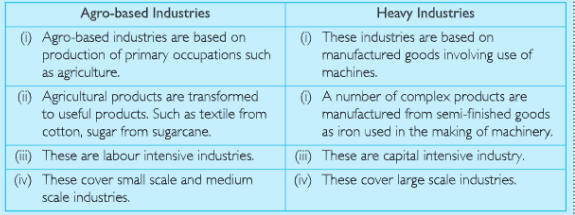
Question 23. Distinguish between Agro-based Industries and Heavy Industries.
geography-table2

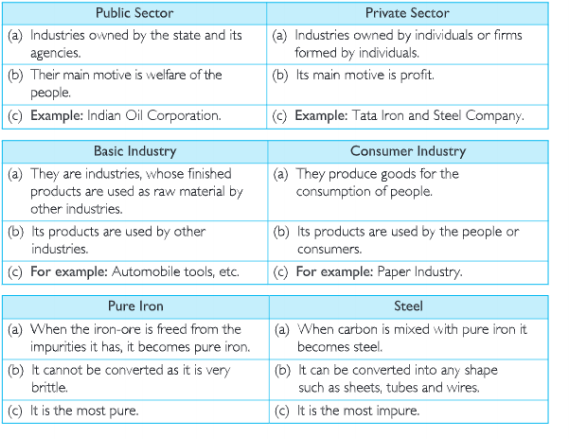
24. Distinguish between:
1. Public Sector and Private Sector.
2. Basic industry and Consumer industry,
3. Pure iron and steel.
geography-table3

Question 25. Based on ownership, name the three sectors of industries. Give examples.

Answer. On the basis of ownership, three sectors of industries are found in India.

  1. Public Sector: These are managed by state, such as Bharat Steel Plant.
  2. Private Sector: These are managed by private management of individuals such as TISCO at Jamshedpur.
  3. Joint or Co-operative Sector: These are managed by co-operative societies such as sugar mills.

KSEEB Class 8 Geography Chapter 5 Important Questions 

Industries Long Answer Type Questions

Question 1. What is an industrial system?

Answer. Inputs, processes and outputs are a part of an industrial system. In it, inputs include raw material, costs of land, labor, transport and other infrastructure along with power. Raw materials are converted into finished goods by processes. The end product is the output along with the income earned from it Inputs included in the cotton textile industry are cotton, labor, transport and factor)’ cost Ginning, spinning, weaving, dyeing and printing are the processes and the output is the cloth (or shirt).

Question 2. What are the important factors of modern industry?

Answer. The important factors of modem industry are as follows;

  1. Raw material is the basic ingredient of a modern industry.
  2. Capital is necessary for purchasing raw material and for paying wages.
  3. Power provides motive force to machines that are installed for production.
  4. Market means sufficient demand for finished goods.
  5. Skilled labor is also required to operate machines and process raw material of the finished goods.
  6. Transport facilities are also vital for modern industries. They are required to bring raw material to the industry and to support finished goods.

Question 3. Describe the development of Ahmedabad as a cotton textile center.

Answer. Ahmedabad is often referred to as the Manchester of India. It is situated in Gujarat. It is the largest textile center in Gujarat and second largest in India after Mumbai. The first textile mill was set up here in 1859.

Factors:

  1. It is near the main cotton producing belt of India.
  2. Climate is humid and thus suitable for this industry1.
  3. Cheap skilled and semi-skilled labor can be easily received from the surrounding areas.
  4. Ahmedabad has a good network of transport
  5. The textiles from Ahmedabad find ready market in ever)’ part of India.
  6. There are 50 mills in Ahmedabad.
  7. Cheap hydro-electricity is readily available.

Question 4. What are the different bases for classifying industries?

Answer. Industries can be classified on the following ways:

(a)On the basis of Raw Materials:

1. Agro based industries which obtain raw materials from agriculture such as food processing, sugar, cotton industries, etc.
2. Mineral based industries which use minerals as their raw materials such as iron and steel, aluminium, cement and copper industries.

(b) On the basis of Size of Industrial Units:

  1. Large Scale Industries: Iron and steel, cotton textiles and oil refining are examples of Large Scale Industries.
  2. (Most of the industrial units in India come under the category of Medium and Small Scale Industries.
  3. Small Scale Industries: If the industrial unit is small, having very few people employed and the amount of money invested is also not very high, it is called a Small Scale Industry.
  4. Cottage Industries: A wide variety of goods such as carving on woods, making of cane furniture and other items, weaving of cloth or handlooms, making pickles, etc. are produced in very small units mostly in homes with the help of family members only. These industries are known as cottage industries.

    (C) On the basis of ownership:

    Depending upon the nature of ownership, the industries may be classified as private, co-operative,
    public and joint sector industries.
    1. Private Industries’ An industry owned and managed by an individual or a group of individuals is called a Private Sector Industry
    2.Cooperative Industries: If the ownership of an industry belongs to co-operatives, t is called Central Cooperative Sector (formed by a group of people) Industry-
    3.Public Sector Industries: If the government, center or the state, is the owner of an industry, it is called a Public Sector Industry.
    4. Joint Sector Industries: Industries setup, owned and managed in co-operation between the government and the private initiative are called Joint Sector Industries.
    5.Multinational Companies: In recent years, a number of industries have been set up in collaboration with foreign investors. They are called Multi National Companies.

Question5. What is information technology? What are the main centers of information technology in India? Describe its development in the Silicon Valley.

Answer. Radio, telephone, telegraph, television, fax and computer connect people in different parts of the world. These have made our lives much comfortable. By using technologies such as computers, calculators, telephones and various electronic equipments, we can store, process and distribute information at a great speed and is called Information Technology
Main Centers in India: Bengaluru, Hyderabad Mumbai, Pune, Chennai, Delhi-Noida-Gurgaon belt, Chandigarh and Thiruvanantapuram are some of the important centers of the Information T technology. Indian companies are becoming proficient in chip design, web-based services and telecom software, among other fields. India has emerged as one of the great leaders in this field.

Silicon Valley is located in west central California. It contains about 50 kilometre by 20 kilometres strip of land in Santa Clara County between the cites of San Francisco and San Jose. Today, Silicon Valley is considered one of the greatest ‘science pa’ks1 in the world that contains hundreds of high-tech information technology industries.
It is an important information technology center in the USA. Several large companies such as Intel, the world leader n making microprocessors, Apple Computer, makers of computer, Hewlett- Packard, and Sun Microsystems are located in the Silicon Valley. The foundation of Silicon Valley was laid at Stanford University, for supporting research in the post World War II period. The Stanford University was developed as Stanford Research Park in 1951. Electronic industries were invited to set up their firms in this park. The University provided the land and facilities. Professor Frederick Emmons Terman, planned this knowledge-based electronic industry region centered in the University. He is, therefore, called the father of the Silicon Valley.

Question 6. What is an Industrial Region? Describe the major Industrial Regions of India.

Answer. With the development of an industry in a region, other industries also get attracted to that region. Sometimes, industries also cluster’ together. Such clusters are known as industrial regions or complexes.
India has eight industrial regions in India:
1. Mumbai-Pune Region which extends from Thane to Pune and the adjoining districts of Nasik and Sholapur,
2. Hugli-Region extends from Bansbaria in the north to Birlanagar in the south;
3. Bengaluru-Tamil Nadu Region extends from Bengaluru to all parts of Tamil Nadu except Villupuram;
4. Gujarat Region lies between Ahmedabad and Vadodara in the south to Jamnagar in the west;
5. Chhota Nagpur Region extends over Jharkhand, northern Odisha and western West Bengal;
6. Vishakhapatnam-Guntur Region extends from Vishakhapatnam district to Kumool and Prakasam districts in the south;
7. Gurgaon-Delhi-Meerut Region includes Gurgaon, Delhi.
8. Kollam-Thiruvananthapuram Industrial Region.

geography map

Industries Hots Corner

Question 1. How is the economic strength of a country judged?

Answer. Development of Industries.

Question 2. Name the emerging industries.

Answer. Industries such ad IT, Hospitality, knowledge and welfare are known as ’Sunrise Industries’ as these are emerging industries.

Question 3. What is GMR?

Answer. GMR means Great Mineral Region at India including states of West Bengal, Jharkhand, Odisha and Chhattisgarh.

Question 4. What is an industrial region?

Answer. With the development of an industry in a region, other industries also get attracted to that region. Sometimes, industries also cluster together. Such clusters are known as industrial regions or complexes.

Detailed Notes On Industries KSEEB Geography 

Question  5. Why is the Iron and Steel industry called basic industry?

Answer. It is called basic industry because it provides Iron and Steel for manufacturing tools and machines for various construction purposes. This is a feeder industry-‘ whose products are used as raw material for other industries.

Question 6. How did Stanford University help in the development of Silicon Valley?

Answer. The foundation of Silicon Valley was laid at Stanford University. Stanford alumni David Packard and William Hewlett established a small electronic company. It developed as research park and later Electronics industries and knowledge based industries were developed.

Question 7. What are the different stages in the production of a book?

Answer. This process starts with the growth of a tree. Tree is cut and transported to the pulp mill. Wood is converted into wood pulp. Chemicals are used with wood pulp to convert it into paper. Paper is printed and folded into a book

Question 8. Name three industrial regions of the world.

Answer. The industrial regions of the world are:

  1. Western Europe
  2.  Eastern part of North America
  3.  Eastern Asia.

Question 9. What are the risk reduction measures in industries?

Answer. The risk reduction measures in industries are:

  1. Care should be taken so that the industrial areas should be far away from the residential areas.
  2. Improvement should be done regarding the storage capacity of toxic substances.
  3. Improvement should be taken up regarding lighting system and fire warning.
  4. improvement should be done regarding the pollution dispersion qualities of the industries.
  5. Toxics and hazardous substances are abundant in and around industrial areas. People residing near such areas should be aware of the risks involved and the possible effects in case of an accident.

Question 10. Discuss briefly about the Bhopal Gas Tragedy.

Answer. The Bhopal gas tragedy was one of the worst industrial disasters that occurred in Bhopal. It happened on 3rd Dec. 1984 around 12:30 a.m. when most of the people were sleeping. A highly toxic gas known as methyl isocyanate or MIC, as it is popularly known, along with Hydrogen Cyanide leaked from the Union Carbide pesticide factor)-. Thousands of people died (official death toll was 3,598 in 1989). Thousands are still suffering from one or many ailments like blindness, impaired immune system, etc.

Simplified Notes For KSEEB Class 8 Geography Industries 

Industries Map Based Questions

Question 1. Locate the major iron-ore producing areas on the map of the world.
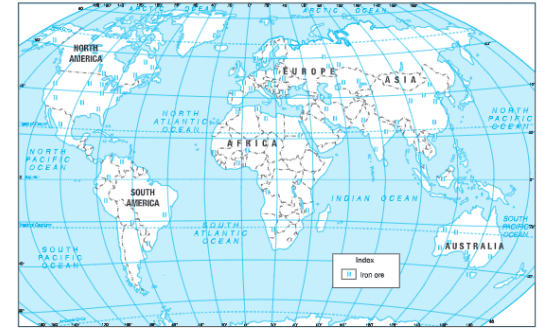
geography glob
Major Iron Ore Producing  Areas of the World

Question 2. Locate the major Cotton Textile Manufacturing Regions on the map of the world.
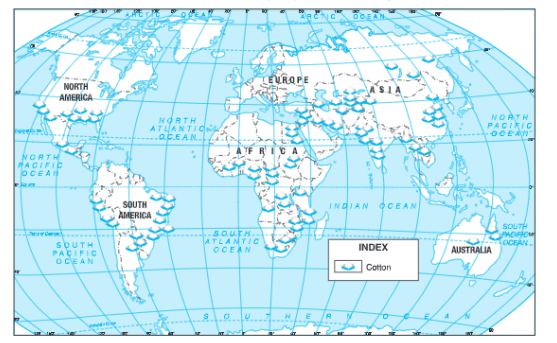
geography glob 2

Major Cotton Textile Manufacturing Regions of the World

Industries Miscellaneous Questions

A. Multiple Choice Questions

Tick the correct option from the choices provided:

Question 1. Which type of activity is manufacturing?

(a)Primary
(b)Secondary
(c)Tertiary
(d)Quartemary

Answer. (b) Secondary

Question 2. Which of these is an agro based industry?

(a)Iron and Steel
(b)Railway Engines
(c)Cotton Textile
(d)Building Materials

Answer. (c) Cotton Textile

Question 3. Which of these is a mineral based industry?

(a)Cotton Textile
b)Food Processing
(c)Iron and Steel
(d)Vegetable oil

Answer. (c) Iron and Steel

Question 4. Heavy machinery industry is a_____ industry.

(a)Agro based
(b)Mineral based
(c)Marine based
(d)Forest based

Answers. (b) Mineral based

Question 5. Pharmaceutical industry is a_____ industry.

(a)Forest based
(b)Agro based
(c)Mineral based
(d)Marine based

Answer: (a) Forest based

Question 6. Tata Steel is an industry of ______type.

(a)Public Industry
(b)Private Industry
(c)Joint Industry
(d)None

Answer. (a) Public Industry

Question 7. When did the Bhopal tragedy take place?

(a)1982
(b)1983
(c)1984
(d)1985

Answer. (c) 1984

Question 8. When was Tata Iron and Steel Plant established?

(a)1905
(b)1906
(c)1907
(d)1908

Answer. (c) 1907

Question 9. When was the first cotton mill established in Kolkata?

(a)1816
(b)1817
(c)1818
(d)1820

Answer. (c) 1818

Question 10. Which town is called the Manchester of India?

(a)Ahmedabad
(b)Mumbai
(c)Kolkata
(d)Kanpur

Answer. (a) Ahmedabad

Industries B. One Word/Sentence Answers

Answer the following questions in one word/sentence:

1. When was the first Cotton Textile Mill set up in India?

   Answer. 1854

2. Give an example of Joint Sector.

Answer. Maruti Udyog

3. Give an example of Co-operative Sector Industries.

Answer. Anand Milk Union Ltd

4. Name the harmful effects of many industries.

Answer. Pollution

5. Which country is the largest producer of steel in the world?

Answer. China

6. Which sector of the Textile Industry is the oldest industry of the world?

Answer. Cotton textile industry

7. Who is called the father of Silicon Valley?

Answer. Professor Frederick Emmon Terman.

8. Which city is known as ‘Manchester of Japan’?

Answer. Osaka

(9. What is the raw material of textile industry?

Answer. Fibres

10. Name a steel plant located at a port.

Answer. Vishakhapatnam

11. From which raw material is paper manufactured?

Answer. Wood

12. Where does India rank in world production of steel?

Answer. 9th

13. Name a method of treating water.

Answer. Recycling

Industries C. Fill in the Blanks

Fill the blanks with appropriate terms in the following sentences:

1. _______ and_____ are two examples of basic industries.

Answer. Automobiles and machines tools

2. ______and_____ are two agro-based industries.

Answer. Cotton textile industry and vegetable oil industry

3. ______and____ are two examples of animal-based industries.

Answer. Dairy industry- and meat industry

4. _____ and_____ are two examples of Consumer Industry.

Answer. Bicycle Industry and paper Industry

5. ______and____ are two countries of the world known for automobile Industry.

Answer. Japan and China

6. _____and____ are two industrial regions of India located near the sea ports.

Answer. Mumbai and Chennai

7. ____ ____ and _____ are three information technology centres in India.

Answer. Bengaluru, Hyderabad, Mohali.

8. _____are _____major basis of classification of the industries on the basis of size.

Answer. Small scale and large scale

Industries D. Picture Interpretation

Look at the following picture and answer the questions that follow:

  1. Identify the major industrial regions marked as A to H on the below map. What does the alphabets denotes on the map?

geography map 2

Answer. The shadowed area is showing industrial region on the map. The alphabets represent the following on the map:

A. Gurgaon-Delhi-Meerut Region includes Gurgaon, Delhi;
B. Hugli-Region extends from Bansbaria in the north to Birlanagar in the south;
C. Chhotanagpur Region extends over Jharkhand, northern Odisha and western West Bengal;
D .Gujarat Region lies between Ahmedabad and Vadodara in the south to Jamnagar in the west;
E. Mumbai-Pune Region which extends from Thane to Pune and the adjoining districts of Nasik and Sholapur;
F. Vishakhapatnam-Guntur Region extends from Vishakhapatnam district to Kumool and Prakasam districts in the south;
G. Bengaluru-Tamil Nadu Region extends from Bengaluru to all parts of Tamil Nadu except Villupurams
H. Kollam-Thiruvananthapuram Industrial Region.

KSEEB Solutions For SSLC English Class 10 Poem Chapter 7 The Blind Boy

SSLC English Class 10 Chapter 7 The Blind Boy Summary

The poem, The Blind Boy is about a blind boy talking about all of the things he cannot see in life. The poem starts with an innocent question of which is very touchy. He innocently asks what is the Tight’ that people talk about and he has no knowledge about it. For him day and night are not different. He talks about the sun and tells of how he can feel the warmth of it, but doesn’t understand day and night because he doesn’t know what the sun shining is like.

He decides it is night when he feels sleepy and it is day when he is active. The poet gives the message of optimism in the last section of the poem. The boy says he often hears people pitying him for his blindness but he does not feel sorry for not having something which he does not know at all.

He says he is not going to worry about the thing he does not have but enjoy his life as it is presented to him by the lord. In the last two lines the boy celebrates his life and says that he is the king of his life though he is blind.

The poem is a message of being optimistic in life despite the weaknesses and shortcomings.

KSEEB Solutions For SSLC English Class 10 Poem Chapter 7 The Blind Boy

KSEEB Solutions For SSLC English Class 10 Chapter 7 The Blind Boy Understands the Poem

Question 1. Whose is the voice of the Poem?
Answer: The voice of the poem is that of a blind boy.

Question 2. ‘The blessings of the right, – line 3. Can you list out a few of them?
Answer: If we have the blessing of sight we shall be able –
1) to see our family members, friends, and relatives.
2) see the beautiful world around us which is the gift of god.
3) to read and write like a normal human being and become knowledgeable.
4) to see the discoveries and inventions of man and enjoy using them to the fullest.
5) make out what is safe and what is dangerous around us.

Question 3. How does a blind person understand whether itis day or night?
Answer: According to the poet a blind person thinks it a day when he is awake and thinks it is night when he feels sleepy.

Question 4. Read lines 13 and 14. Who is sympathizing with whom?
Answer: In lines 13 and 14, people with eyesight are sympathizing with the blind boy. They are mourning his lack of eyesight.

Question 5. How does the blind pacify himself? Quote the lines that suggest this.
Answer: The blind boy pacifies himself saying that he is not going to let his blindness destroy his joy and cheer. He does not want to crave for what he does not have but will enjoy with what he has been blessed. ‘But sure with patience, I can bear A loss I ne’er can knowThen let not what I cannot have My cheer of mind destroy’

The Blind Boy summary For Class 10 SSLC English Read And Appreciate

Question 1. Who do you think is the person addressed as ‘you; in the poem?
a. Read the first stanza carefully. The tone of the speaker is one of
1) surprise
2) curiosity
3) sadness(choose the appropriate one)
Answer: ‘You’ refers to the people who have normal eye sight who sympathize with the blind boy.
1) curiosity

Question 2. The blind boy can feel of the sun. (fill in the blank)
Answer: warmth

Question 3. What a normal person can easily understand is almost a riddle to the blind boy. What is it?
Answer: The fact that ‘the sun shines bright ’ and the concept of ‘day and night is a riddle to the blind boy. He does not know how the sun shines but he can feel the warmth of the sun. He do not know the difference between day and night. For him it is a day when he is awake and night when he sleeps.

Question 4. Identify the rhyme scheme of the poem.
Answer: The rhyme scheme of the poem is abab

Question 5. Match the following and frame appropriate sentence for each phrase thus marched.

blessings                               wondrous things
cheers of                                        sight
talk of                                            mind

Answer:
1)blessings of sight
2) cheers of mind
3) talk of wondrous things.

SSLC English Poem Chapter 7 The Blind Boy Interesting Activities On Comprehension And Appreciate

Answer the following questions briefly.

Question 1. What do the people mourn about the boy? How does the boy react to it?
Answer: 1) The people mourn the boy’s state of blindness and consider it be a sad part of his life. The blind boy says that he is not sad for his blindness. According to him, he need not feel the loss of something which he doesn’t know.

Question 2. What message do we get from the last stanza of the poem?
Answer: The last stanza of the poem gives a positive message to the normal people as well as the people with disabilities. It provides an insight on how we shouldn’t let things cause us to lose our cheer because things could always be worse. Even though the boy was blind and had that disadvantage in life, he still thinks of himself as a king. He wouldn’t let his deformity come in the way of his enjoyment. Thus the optimistic attitude and spirit is an inspiration to all readers of this poem. The poem also gives the message that we need to be contented and happy in life with what we have rather than brood upon things that we do not have.

Question 3. Write the summary of the poem.
Answer:

The poem, The Blind Boy is about a blind boy talking about all of the things he cannot see in life. The poem starts with an innocent question of which is very touchy. He innocently asks what is the Tight’ that people talk about and he has no knowledge about it. For him day and night are not different. He talks about the sun and tells of how he can feel the warmth of it, but doesn’t understand day and night because he doesn’t know what the sun shining is like. He decides it is night when he feels sleepy and it is day when he is active. The poet gives the message of optimism in the last section of the poem. The boy says he often hears people pitying him for his blindness but he does not feel sorry for not having something which he does not know at all. He says he is not going to worry about the thing he does not have but enjoy his life as it is presented to him by the lord. In the last two lines the boy celebrates his life and says that he is the king of his life though he is blind.
The poem is a message of being optimistic in life despite the weaknesses and shortcomings.

The Blind Boy Class 10 English Read The Following Lines From The Poem And Answer The Questions That Follow

‘I feel him warm, but how can he make it day or night?’

Question 1) Who are the ‘he’ and ‘I’?
Answer:.‘
he’ refers to the sun, ‘I’ refers to the blind boy.

Question 2) Why does the speaker ask the above question?
Answer: because the blind boy cannot see the sun making it day and night.

Question 3) How does the speaker make his day and night?
Answer: For the blind boy it is a day when he is awake and it is a night when he sleeps.

‘I often hear you mourn my hapless woe ’.
Question 1) Who are the ‘I’ and ‘you’ ?
Answer: T refers to the blind boy, ‘you’ refers to the reader or the people with normal eyesight.

Question 2) How does the speaker hear the mourning?
Answer: He hears the mourning of the people through their sighs.

Question 3) How does the speaker react to such mourning?
Answer: The blind boy does not want anyone to mourn for his blindness because he does not feel sorry for not having something which he does not know at all.

KSEEB Solutions For SSLC English Class 10 prose chapter 1 A Hero

KSEEB Solutions For SSLC Class 10 English Chapter 1 Summary A Hero Points to Remember

Swami and Friends is the first of a trilogy of novels written by R.K. Narayan. This lesson ‘A Hero’ is an excerpt taken from the novel. The lesson, though presented in a comic manner, teaches the values of courage, a fight against superstition and the use of presence of mind in a right mariner. Swami doesn’t believe his father when he reads an incident from the newspaper of bravery of a boy fighting with a tiger.  Father says that courage is everything, strength and age are not important. Swami disputes the theory saying that how can he fight a tiger with courage.

Father gives Swami a challenge to sleep alone that night in his office room and prove his courage. Swami tries to distract his father from the challenge through a number of excuses, lie tried to get excuses with the help of his mother and granny but the father wouldn’t agree.

Swami pretentiously slept in his place with granny but his father wakes him and forces him sleep in his office room on a bench in the dark with the door open. At night he is so scared that he remembers all the stories of devils and ghosts he had heard in his life. He gets up and crouches under the bench and after some time falls asleep.  He sees a dream of a tiger chasing him and attacking him He tries to escape but couldn’t move a little.

When he opens his eyes he finds himself alone in the dark. He felt something moving down. He thought it to be a devil, he crawls out of the bench, hugs it with all his might, and uses his teeth on it like a mortal weapon It was a burglar whom Swami had caught. The next day he was congratulated by all his friends and even his headmaster or his brave act. The policemen were grateful for nabbing a notorious housebreaker of the district.

KSEEB Solutions For SSLC English Class 10 prose chapter 1 A Hero

SSLC English Chapter 1 A Hero Textual Exercises To Check Your Understanding

Question1. Swarm’s father drew his attention to a report in the newspaper. What was the report about?
Answer: The newspaper report was that a brave village lad who while returning home by the jungle path came face to face with a tiger. He had a fight with the tiger and climbed up a tree and stayed there for half a day till some people came that way and killed the tiger.

Question2. The report said that the boy (who fought with the tiger) stayed on the tree for half a day. Why did he do so?
Answer:  He wanted someone to kill the tiger.

Question3. Swami said that a very strong and grown up person might have fought with a tiger. Do you think he made this remark out of his (choose the most appropriate word)
Answer:  belief

Question4. “Can you prove you have courage?” Swami’s father said.
1) Was he joking? Or, serious?
Answer: Serious.

Question 2) Was it a challenge? Or, a command?
Answer: a command.

Question5. The place where Swami usually slept was_______(Fill in the blank)
Answer: beside his granny.

Question6. What is disgraceful, according to Swami’s father?
Answer: According to Swami’s father, it is disgraceful to sleep beside granny or mother like a baby.

KSEEB Solutions SSLC English A Hero Share Your Responses

Question 1. What do you think was the practice of granny before she went to bed?
Answer: Granny used to tell stories to Swami before she went to bed.

Question 2. Was Swami really sleeping? Or was he pretending?
Answer: Swami was pretending to sleep.

Question 3. To Swami, his father looked like an
Answer: apparition.

Question 4. Why do you think Swami looked at his granny and his mother while following his father to the room?
Answer: Swami looked at his granny and his mother while following his father to the room with the hope that they would come forward to help him escape from the orders of his father.

Question 5. “There might be scorpions before your law books,” said Swami.
1) Had he seen them earlier? Or were there scorpions really?
Answer: In real there were no scorpions behind the books,

2) Was it a trick to escape from his father?
Answer: Yes, it was a trick to escape from his father

KSEEB SSLC English Class 10 Prose Chapter 1 A Hero Share Your Responses

Question 1. Swami wished that the tiger hadn’t spared the boy, which means…
Answer: he didn’t want the boy to be alive.

Question 2. As silence deepened in the room, what was Did swami remind of?
Answer: As silence deepened in the room, Swami was reminded of all the stories of devils and ghosts he had heard in his life

Question 3. Which place in the room did Swami think was safe, compact and reassuring?
Answer: The safe, compact and reassuring place in the room was under the bench.

Question 4. Swami touched _______in the room instead of granny, (fill in the blank appropriately)
Answer: the wooden leg of the bench

Question 5. Swami saw a moving creature in the room. Was it
Answer: a man

SSLC Class 10 English A Hero Share Your Responses

Question 1. Who cried, “Aiyo! Something has bitten me?”
Answer: The burglar cried.

Question 2. Who did father, cook and a servant stumble upon?
Answer: Father, cook and a servant stumble upon the burglar.

Question 3. Why were congratulations showered on Swami?
Answer: Congratulations were showered on Swami as he had grabbed a burglar who had been the most notorious house-breaker of the district.

Question 4. Do you think Swami really wanted to join the police? If not, what did he want to be?
Answer: No, Swami did not want to join the police. He wanted to be an engine driver, a railway guard, or a bus conductor.

Question 5. Did Swam muster up the courage to sleep alone after the burglar’s incident?
Answer: No, he did not muster up the courage to sleep alone after the burglar’s incident.

Question 6. Who supported Swami? His mother or his granny?
Answer: Swami’s mother supported him

Class 10 SSLC English Chapter 1 A Hero Think About The Text

Question 1. A report about a boy in the newspaper was an unexpected event in Swami’s life. Justify.
Answer: A report about a boy in the newspaper was an unexpected event in Swami’s life. The newspaper report read by his father about the courage of a boy made Swami and his father in an argument in which the father tells him that courage is everything, strength and age are not important. Swami disputes the theory ofhis father. In order to prove his theory, Swami father challenged him to sleep alone that night in his office and prove that he had courage to sleep alone in darkness. The father did not listen to any excuse and made him to sleep there.

Question 2. Swami made a comment on the newspaper report. Was he right? How did his view differ from that of his father?
Answer: Swami made a comment that the person who faced the tiger boldly must be a very strong grownup person, not a boy at all because a boy cannot fight a tiger. Swami was wrong in thinking so because his father was of the opinion that a man may have the strength of an elephant and yet be a coward: where as another may have the strength of the straw, but if he has courage, he can do anything.

Question 3. What desperate attempts did Swami make to escape from his father?
Answer: Swami made desperate attempts to escape from his father’s challenge to him. First he told that he would sleep alone from the next month. Next he slowly went to his bed and slept covering himself completely with a blanket and began to snore.

Question 4. Why did Swami conclude that his father’s proposition was frightful?
Answer: Swami concluded that his father’s proposition was frightful because he had always slept beside his granny in the passage, and any change in that arrangement, kept him trembling and awake all night.

Question5. As the night advanced, S wami felt that something terrible would happen to him. What would it be? How would it happen?
Answer: As the night advanced and the silence in the house deepened, his heart beat faster. He remembered all the stories of devils and ghosts he had heard in his life. He remembered how often his friend, Mani had seen the devil in the banyan tree at his street end. He also remembered Muni swami’s father, who had spat out blood because the devil near the river’s edge had slapped his cheek when he was returning home late one night. His thoughts continued with many more such fears.

Question 6. There was absolute silence in the room. In spite of it, some noises reached Swami’s ears. What were they?
Answer: The noises that reached his ears were the ticking off the clock, rustle of trees, snoring sounds, and some vague night insects humming.

Question 7. Narrate Swami’s dreadful experience when he was lying under the bench.
Answer: After sleeping under the bench, Swami began to dream of being chased by a tiger. He desperately tried to escape but his feet would not move, the tiger was at his back, and he could hear its claws scratch the ground. Then he heard a loud thud but he could open his eyes. With a desperate effort he opened his eyes and found himself under the bench. And his lonely state came back to him. He sweated with fright. He saw something rustling and moving down. He lay gazing at it in horror. He realized that the devil would presently pull him out and tear him. AS it came nearer he crawled out from the bench, hugged it with all his might, and used his teeth on it like a mortal weapon.

Question 8. How was Swami honoured by his classmates, teacher, and the headmaster?
Answer: Swami was showered with congratulations. His classmates at him with respect and his teacher patted his back. The headmaster said that he was a true scout. Swami had bitten into the flesh of one of the most notorious house-breakers of the district and the police were grateful to him for it.

Question 9. Why did father want Swami to sleep alone in the office room? 
Answer: Swami was very dependent and was pampered by his mother and granny. Swami’s father wanted Swami to be self-dependent, bold and courageous. When Swami’s father read the news of a boy lacing a tiger boldly, Swami argued that one has to be a grown-up in order to be courageous. His father tried to convince him by saying that a man may have strength of an elephant yet be a crowd: where as another may have the strength of a straw, but if he has courage, he can do anything. Courage is everything, strength and age are not important. Swami disputed the theory of his father. Swami’s father wanted to show him how lacked courage so he wanted Swami to sleep alone in the office room.

Question 10. Who do you think was wiser, Swami or his father? Justify your preference.
Answer: Swami’s father was obviously wiser due to age and experience. He had seen and experienced the world where as Swami was still a small boy who was pampered and well protected by his mother and granny.

Question 11. Why did Swami feel relieved at the end?
Answer: Swami felt relieved when his father agreed to allow Swami sleep in his original place beside his granny.

Question 12. Suppose you are Swami of the story. Write a brief letter to your friend describing how you helped to catch a burglar in your house.
Answer: Students to answer.

Question 13. Some words describing the characters of the story A Hero’ are given in brackets. Put them in these columns appropriately.
Answer: Swami’s father: tricky, authoritative, disciplined. Mother: caring, protective.
Granny: caring, protective.
Swami: innocent, helpless, nervous.

KSEEB English Class 10 Chapter 1 A Hero Enrich Your Vocabulary

Task 1: Homophones. Fill in the blanks with appropriate word.
1. We had______ many apples to carry.
Answer: too

2. I_______ a horse at the Marirma Beach.
Answer: rode

3. Did you have a ______for lunch?
Answer: pare

4. The books are over on the shelf
Answer: there

Task 2: Fill in the blanks choosing the appropriate word and complete the story.

This is a __I_______told by a__2_____Once he received a letter. When he  .3 ______it___4 ____he could not believe his own eyes. ___5____ it was written ____6 _____none other than the queen of the land. She asked him to meet her___ 7 _______a secret place. The knight was in a fix. But he thought ___8_____ a plan to tide over this problem. He_____9 to the meeting place, not alone, but along with his ___10 _______wife. Can you guess what happened then?

Answers:
1) Story
2) Knight,
3) Read
4) Through
5) For
6) By
7) At
8) Of
9) Went
10)Fair

Task 3: Scramble the letters to form words. See the meaning clues in brackets.

1. a t r t e f 1______ (praise)
Answer: Flatter

2. b o u d t______ (suspect)
Answer: Doubt

3. r a g g e d y _______(unhappy ending)
Answer: Tragedy

4. r a g f e n m t _____(apiece)
Answer: Fragment

5. r a e t l ____(careful)
Answer: Alert

6. c a c s r l y t_____(short supply)
Answer: Scarcity

7. y m t a s t h p e i c (not cruel)
Answer: Sympathetic

KSEEB Solutions For SSLC Class 10 English Chapter 1 A Hero Practice Writing

Briefly explain what is funny about each of these signs given in italics. (Reframe them to read appropriately
Answer:
1. Our best homemade pies for you.
2. Wanted two waiters and a young dish washer (maid) for the restaurant.
3. Fast haircut while you wait.
4. We sell lawnmowers here.
5. Instant soft drinks are sold here.

Learn grammar through communication.
1) Rewrite the sentences beginning with the ‘clue’ given in brackets.
2) Identify the language function.

Question 1. Please return my library books.
Answer:

1) Will you please return my library books?
2) Making request

Question 2. The files are heavy I’ll carry them for you.
Answer:
1) Would I carry these files for you?
2) Offering help.

Question 3. That’s your essay. Perhaps you have no objection if I see it.
Answer:
1)May 1 see your essay?
2) Seeking permission.

Question 4. Let me switch on the fan, OK?
Answer:
1) Do you mind if I switch on the fan? OR – Do you mind me switching on the fan?
2) Making offers or preferences.

Question5. Bring the books to my office.
Answer:
1) Would you please bring the books to my office? OR – Would you mind bringing books to my office?
2) Making request.

KSEEB SSLC English Class 10 Prose Chapter 1 A Hero Dictionary work

The box contains the words that have their synonyms in the lesson. Find them out and write them along with the sentences in which they are used.

Shameful   lose conscious   proposal or suggestion murmured unclear or indefinite covered moan or grumble extremely in the middle of accused shake with fear

Answers:  
1. shameful – disgraceful
2. lose conscious – faint
3. proposal or suggestion- proposition
4) murmured – mumbled
5) unclear or indefinite – vague
6) covered-encased
7) moan, grumble – groan
8) extremely- tremendously
9) in the middle of- amidst
10) accuse -blame
11) tremble – shake with fear

SSLC Class 10 English A Hero Derogatory  Terms

Text Box A has the derogatory terms and Text box B has their synonyms. Match them and write them together.
Derogatory  Terms

Answers:
1-f
2-h
3-e
4-d
5-a
6-b
7-c
8-g

Homophones: There are many words in the lesson for which homophones can be added. Read the lesson in pairs and find them out and add the other word to make pairs of homophones and find out their synonyms. One example is done for you.
Example: groan – grown
Answers:
1) By-buy
2) Face-phase
3) New-knew
4) Know-no-now
5) Night-knight
6) Weak-week
7) Once-ones
8) Leave-live
9) Feet-feat
10) Eyes-ice
11) Way-weigh
12)Forth-fourth
13) Break-brake
14) Peace-piece
15) Whole-hole
16) Hear-here
17) Claws-clause

Use the following words in sentences first as verbs and then as nouns:

1. trouble
Answer: trouble (v): Children should not trouble their parents.
trouble (n): The boy was in trouble due to his mischief.

2. produce
Answer: produce (v): Modem refrigerators do not produce
much sound.
produce (n): The agricultural produce has increased credibly due to scientific methods.

3. Pay
Answer: pay (v) Students should pay attention to their studies.
pay (n): Employees get their salaries on the first of every month.

4. Ride
Answer: ride (v): Raju likes to ride his bike very fast.
ride (n): We had a jolly ride on the elephant in Bandipur National Park.

5. Thought
Answer: thought (v): I have thought of visiting my native place
this weekend.
thought (n): The thought of visiting my Kashmir thrills me.

6. slap
Answer: slap (v): Children should never be slapped on the
face.
Slap (n): Ravi had a slap on his cheeks by his brother for telling lies

KSEEB SSLC English Class 10 Prose Chapter 1  A Hero Interesting Activities On Comprehension And Composition

Question 1. The report about the boy was that the boy
1) Had killed a tiger
2) Had saved a tiger
3) Faced the tiger boldly
4) Called the people to kill the tiger
Answer: 3) Faced the tiger boldly

Question2. Swami disputed the theory of his father because Swami believed that
1) Only strong and grown-ups can face the danger
2) Strength grows with age
3) Courage is nothing to do with age
4) One cannot face the danger only with courage
Answer: 1) Only strong and grown-ups can face the danger

Question 3. ‘Any change in this arrangement kept him trembling… ’ The arrangement refers to
1) Swami used to sleep alone in his room
2) Swami used to sleep beside his granny in the passage
3) Swami slept beside his mother in her room
4) Swami had to sleep in the office room of his father
Answer: 2) Swami used to sleep beside his granny in the passage

Question 4. He knew his father’s tenacity at such moments. The word ‘tenacity’ means
1) Confusion
2) Commands
3) Mood
4) Determination
Answer: 4) Determination

Question 5. ‘Don’t talk to me, and don’t let anyone call me… ’, Swami said so
1) Because he was feeling very sleepy
2) In order to show his anger to his father
3) Because he didn’t want his father know about his sleeping there
4) Because he didn ’ t want to sleep with his granny
Answer: 3) Because he didn’t want his father know about his sleeping there

Question 6. ‘It seemed to be a much safer place, more compact and reassuring’. The place was
1) Under the bench in office room
2) The office room with lights on
3) Beside his granny in the passage
4) Outside the office room
Answer: 1) Under the bench in office room

Question 7. He looked like an apparition in the semi-darkness of the passage. The figure of speech used here is
1) Synecdoche
2) Metaphor
3) Personification
4) Simile
Answer: 4) Simile

Question 8. As it came nearer he crawled out from the bench, and hugged it with all his might. Swami had hugged
1) His father
2) The devil
3) His granny
4) Burglar
Answer: 4) Burglar

Class 10 SSLC English Chapter 1 A Hero Read The Following Answer The Questions That Follow

You think you are wiser than the Newspaper?’

Question 1) Who is the ‘you’?
Answer: Swami

Question 2) What was the news report?
Answer: The news report was about the boy who faced a tiger boldly.

Question 3) Why did the speaker say so?
Answer: Because Swami refused to believe the news report.

‘Can you prove you have courage?’
Question 1) Name the speaker and who is the ‘you’?
Answer:
The speaker was Swarm’s father. ‘You’ refers to Swami.

Question 2) How was the listener supposed to prove his courage?
Answer:
He was supposed to prove his courage by sleeping alone in his father’s office room at night.

Question 3) What was the reply of the listener?
Answer: Swami unwillingly said ‘yes’ and tried to change the topic of their conversation.

‘If you do it, I’ll make you the laughing stock of your school’.
Question 1) What is the ‘it’ refers to?
Answer: ‘
It’ refers to Swami sleeping beside his granny at night.

Question 2) Why was the person not supposed to do it?
Answer:
Swami was not supposed to do it because he had taken the challenge of sleeping alone in the office room of his father that night.

Question 3) Give the meaning of‘laughing stock’.
Answer: an object of ridicule.

‘Aiyo! Something has bitten me’.
Question 1) Name the speaker.
Answer: T
he burglar.

Question2) What had bitten the speaker?
Answer:
Swami had bitten him.

Question3) Why was the speaker bitten?
Answer: Swami bit him in defense thinking that it was a ghost.

Class 10 SSLC English Chapter 1 A Hero Gap Filling

Choose the best word from the options given below to complete the following letter.
Dear Daddy
I hope all’s well with you. Everything is fine here. I am sorry I (1)_____ write earlier. I was busy with my coaching camp (2)______ is now over. After the annual examination, most of (3)______ boarders have left for their homes. Only a few like me (4)_______ left behind. I can’t express how badly I miss you all. I don’t
know (v)_____ I’ll be able to join you. Dad, I hate (vi)_____ a border. How lonely
it is to stay here during the vacation! The few inmates left are not only boring but also nasty. I hope you will come to my rescue soon.

Options:
1) (a) couldn’t) hasn’t c) have not d) hadn’t
2) (a) which b) being c) to d) only
3) (a) which b) the c) are d) when
4) (a) couldn’t b) which c) when d) are
5) a) the b) being c) when d) am
6) a) being b) which c) to d) couldn’t

(1) a
(2) a
(3) b
(4) d
(5) c
(6) a

KSEEB Solutions For Class 8 English Reader Chapter 8 Jalebis

KSEEB Solutions for Class 8 English Reader Chapter 8 Jalebis Summary In English

The story relates to the author’s childhood. He was in the fifth standard at the government school Kambelpur, now called Atak. One day he went to school with four rupees in his pocket to pay the fee and funds. On reaching the school he found that the teacher who collected the fee, Master Ghulam Mohammed, was on leave.

Therefore the fee was to be collected the next day. When the school got over and he came out, the coins in his pocket began to speak.

Although the coins don’t talk, they ‘ingle. But the author assured the readers that they actually spoke that day .They began to entice him to buy hot Jalebis and eat them. But the author warned them not to misguide him.

He told that he got so much at home that he considered it a sin to look at anything in the market. But their noise attracted even the passersby. In a panic, the author held them tightly in his fist to silence them.

But as soon as he loosened his grip they opened their mouths again and persuaded him to spend them on piping hot jalebis.

The author told them that he was one of the best students in his class. He had even won a scholarship of four rupees a month. He would get the scholarship money the next day. The coins created so much fuss that he was forced to rush barefoot towards the bazaar. He bought jalebis for one rupee. Those were low priced days.

One rupee fetched more than what twenty rupees fetch nowadays. He ate jalebis more than his stomach could d gest hisdistributed the remaining jalebis to the children around. He also bought jalebis for the remaining three rupees and distributed liberally among the children and some beggars.

He washed his hands and face and returned home. At night he had to eat his dinner as well. So all night he lay, coiled up like a Jalebi. He had an acute stomach ache. Next day when he got to school, he came to know that the scholarship was going to be paid the following month. When the recess bell rang, he left the school and reached where the Kambelpur railway station began.

He sat under a shady tree beside the railway tracks. He had eaten jalebis with the fee money thinking that he would pay the fee with the scholarship money. But he was not going to get this money before a month. He began to pray to Allah Miyan to put four rupees in his bag, but to no avail. Tired and defeated he started for home.

The next day he did the same thing. He went upto the school gate and then turned off to the railway station. Under the same tree, he spent school hours praying to Allah Miyan. Then he left for home, apparently from school. He was caught. The report of his absence had reached home. He did not want to recall the happenings after that.

The author kept thinking as to what loss would have Allah Miya incurred if he would have paid h:m four rupees. However, later he did realise that if AlIah Miya would listen to all such requests, people would stop working hard and keep wasting time in prayers.

KSEEB Solutions For Class 8 English Reader Chapter 8 Jalebis

Class 8 English KSEEB Jalebis Summary In Hindi

कहानी का सम्बन्ध लेखक के बचपन से है। वह गर्वमेंटन स्कूल कम्बलपुर में जिसे अब अटक कहा जाता है, पाँचवी कक्षा में पढ़ता था। एक दिन वह फ़ीस तथा फंड देने के लिए अपनी जेब में चार रूपये लेकर स्कूल गया। स्कूल पहुंच कर उसे पता चला, फीस लेने वाले अध्यापक मास्टर गुलाम मोहम्मद छुट्टी पर हैं। जब छुट्टी हुई और वह बाहर आया उसकी जेब में पड़े सिक्के बोलने लगे। यद्यपि सिक्के बातें नहीं करते, वे खन खनाते हैं। परंतु लेखक पाठकों को विश्वास दिलाता है कि उस दिन वे वास्तव में ही

बोले थे। उन्होंने उसे गर्मागरम जलेबियां खरीदकर खाने के लिए ललचाया परंतु लेखक ने उन्हें चेतावनी दी कि वे उसे मात बहकायें। उसने उन्हें बताया कि उसे घर में इतना अधिक मिलता है कि वह बाजार में किसी चीज़ को देखना भी पाप समझता है। परंतु उनके शोर ने राहगीरों को भी आकर्षित किया। भय के मारे लेखक ने उन्हें शांत करने के लिए अपनी मुट्ठी में जोर से भींच लिया। परंतु जैसे ही उसकी पकड़ ढीली हुई, उन्होंने फिर से अपना मुंह खोल लिया। उन्होंनें लेखक को इस बात पर मनाने के लिए अपना पूरा जोर लगा दिया कि वह उन्हें गर्मागरम जलेबियों पर खर्च कर दे।

लेखक ने उन्हें बताया कि वह अपनी कक्षा में सबसे अच्छे छात्रों में से एक है। उसने घार रूपये मासिक छात्रवृत्ति के पैसे उसे अगले दिन मिलेंगे। सिक्कों ने इतना हो-हल्ला किया कि वह घर से नंगे पांव बाजार की और भागने पर मजबूर हो गया। उसने एक रूपये की जलेवियां खरीद लीं। वह सस्ता ज़माना था। एक रुपये में इतना कुछ मिल जाता था जितना आज बीस रूपये में भी नहीं मिलता। वह जलेबियों की अपनी छाती से चिपका कर एक गली की ओर भागा। वह अपनी पाचन शक्ति से भी अधिक जलेबियां खा गया। बाकी जलेबियां उसने इधर-उधर खड़े बच्चों में बांट दीं। उसने बाकी तीन रूपयों को भी जलेबियां खरीदीं और उन्हें बच्चों तथा कुछ भिखारियों के बीच बांट दिया।

वह अपने हाथ-मुहं धोकर घर वापिस आ गया। रात को उसे अपना भोजन भी करना पड़ा। इसलिए सारी रात वह जलेबी की तरह ऐंठ कर पड़ा रहा। उसके पेट में बहुत अधिक पीड़ा हो रही थी। अगले दिन जब स्कूल पहुंचा तो उसे पता चला कि छात्रवृत्ति के पैसे अगले महीने मिलेंगे। जब आधी छुट्टी की घंटी बजी तो वह स्कूल से चला गया और वहां पहुंच गया

जहां कम्बलपुर रेलवे स्टेशन शुरू होता था। वह रेल पटरियों के साथ एक छायदार वृक्ष के नीचे बैठ गया। उसने यह सोच का फीस के पैसों की जलेबीयाँ खाई थी कि वह छात्रवृत्ति के पैसों से फीस चुका देगा। परंतु उसे एक महीने से पहले यह पैसे नहीं मिलने वाले थे। उसने अल्लाह मियां से प्रार्थना की कि वह उसके थैले में चार रूपये डाल दें परंतु कुछ न हुआ। थका-हारा वह घर की ओर चल पड़ा।

अगले दिन उसने वही किया। वह स्कूल गेट तक गया और फिर रेलवे स्टेशन की ओर मुड़ गया। उसी वृक्ष के नीचे उसने स्कूल का समय अल्लाह मियां से प्रार्थना से गुज़ारा फिर वह घर की ओर चल पड़ा मानों वह स्कूल से आया हो। वह पकड़ा गया। उसकी अनुपस्थिति की सूचना उसके घर पर पहुंच चुकी थी। उसके बाद की घटनाओं का वह वर्णन नहीं करना चाहता था। जो होना था, हो गया था। वह सोचता रहा कि यदि अल्लाह मियां ने उस दिन उसे चार रूपये भेज दिये होते तो किसी का क्या बिगड़ जाता। उसे बाद में ही यह आभास हुआ कि यदि अल्लाह केवल मांगने से ही दे देते तो लोग मेहनत करना छोड़ देते और प्रार्थनाओं में समय बरबाद करते।

 Jalebis Word Meanings


Chapter 8.1

Chapter 8.2

KSEEB Class 8 English Reader Solutions For Jalebis 

Jalebis Textbook Exercises Comprehension Check 1

Question 1 Why didn’t he (the author as a student) pay the school fee on the day he brought money to school?

Answer. The author didn’t pay the school fee on the day he brought money because the teacher who collected the fee, Master Ghulam Mohammad, was on leave.

Question 2.

(1) What were the coins ‘saying’ to him?
(2) Do you think they were misguiding him’

Answer.

(1) The coins were enticing him to spend them on buying hot jalebis.

(2) Yes, they were misguid ng him. He was a good boy and belonged to a noble family. He got much more at home.

Question 3.Why didn’t he take the coins’ advice? Give two or three reasons.

Answer.

  • He was a good boy.
  • He got so much a: home that he considered even looking at something in the market a sin.
  • The money he had was for the school fee and he did not want to spend it

Question 4.

(1) What did the oldest coin tell him?
(2) Did he follow his advice? If not, why not?

Answer.

(1) The oldest coin asked him to tell the other coins honestly if he did not feel like eating those hot jalebis. He advised him to buy sweets with the fee money and pay fee with the scholarship money,
(2) No, he did not follow his advice. He belonged to a noble family. He enjoyed considerable prestige. For a child of such status, standing in the mddle of the bazaar eating jalebis was not right.

Question 5.He reached home with the coins in his pocket.What happened then?

Answer. When he reached home the coins began to speak and shriek Thoroughly fed up. he rushed out of the house barefoot and ran towards the bazaar. Thus, they forced him to buy jalebis.

Jalebis Comprehension Check-2

Question 1.

(1) Why didn’t he eat all the Jalebis he had bought?
(2) What did he do with the remaining jalebis?

Answer.

(1) There were so many jalebis. Therefore he could not eat all.

(2) He distributed the remaining jalebis among the children who had collected around him.

Question 2.”The fear was killing me.” What was the fear!

Answer. The author had eaten so many jalebis that his stomach could not digest He was in constant fear that with every- breath a burp would come and w ith every- burp a jalebi or two would come out. Thus his secret of eating ^alebis would be exposed.

Question 3.”Children’s stomachs are like digestion machines.” What do you understand by this? Do you agree?

Answer. Children are playful by nature and even f they overeat the food gets digested easily. Their digestion system is quite strong unlike elders. In the story too, the narrator overate but got normal the next morning.

Question 4.How did he plan to pay the fees the next day?

Answer. He planned to pay the fees with the scholarship money he expected to get the next day.

Question 5.When it is time to pay the fees, what does he do? How is he disobeying the elders by doing so?

Answer. When it is time to pay the fees, he leaves the school and reaches a deserted comer of the railway station. The elders had forbidden him to cress the railway tracks and eat sweets with one’s fees money. He is, therefore, disobeying his elders.

Jalebis Class 8 KSEEB Questions And Answers 

Jalebis Comprehension Check-3

Question 1.What was the consequence of buying jalebis with the fees money?

Answer. Buying jalebis with the fees money created a problem for him. hie had to flee from the school and spend the school time under a shady tree in a deserted comer of the railway station.

Question 2.His prayer to God is like a lawyer’s defence of a bad case. Does he argue his case well? What are the points he makes?

Answer. Yes, he argues his case well. In his address to Allah Miyan he says that he is a good boy. He has memorised the entire namaaz, last ten surats of the Quran and the entire ayat-al-kursi. He appeals Him to help him just once.

Question 3.He offers to play a game with Allah Miyan.What is the game?

Answer. The game is that he will run to the signal. In the meantime, Allah Miyan will secretly place four rupees under the big rock

Question 4. Did he get four rupees by playing the game? What did he get to see under the rock?

Answer. No, he did not get four rupees by playing the game. He got to see a big hairy’ worm under the rock

Question 5. If God had granted his wish that day, what harm would it have caused him in later life?

Answer. If God would have granted the author’s wish that day, he would have indulged in blind faith. He would have become lazy, idle and complacent

Jalebis Exercise

Work in small groups.

Question 1. Select and read sentences that show.

(1)that the boy is tempted to eat jalebis.

(2)that he is feeling guilty.

(3)that he is justifying a wrong deed.

Answer.

(1) But then, these jalebis are no common sort of jalebis and they are crisp, fresh and full of sweet syrup.

(2)Sitting there under the tree, at first I felt like crying.

(3)I didn’t eat them all by myself though I fed “.hem to a whole lot of children too…

Question 2.Discuss the following points:

(1)Is the boy intelligent? If so, what is the evidence of it?

(2)Does his outlook on jalebis episode change after class VIII? Does he see the episode in a new light?

(3)Why are coins made to ‘talk’ in this story-? What purpose does it serve?

Answer.

(1) Yes, the boy is very intelligent. The story’ tells that he was a promising student He had won a scholarship in the IV standard exams. He had even memorized the entire namaaz, last ten surats of the Quran and the entire ayat-al-kursi.

(2)Yes, his outlook on the jalebis episode changes after class VIII. He comes to the conclusion that if Allah Miyan were to provide for all the asking and requests, then man would have been idle and lazy.

(3)The coins are made to talk to give the story a humorous touch. The purpose it serves is that money in the pod<et makes even a wise man go astray.

Explanation of Jalebis KSEEB Class 8 

Jalebis Additional Questions Very Short Answer Type Questions

Question 1. For what purpose was the boy (author) carrying money in his pocket!

Answer. He was carrying money to pay the school fees.

Question 2. What attracted the boy in the market?

Answer. The sight of crisp, sveet jalebis in the market attracted him

Question 3. How did the boy get rid of the pile of Jalebis he had bought?

Answer. He got rid of the jalebis by eating and sharing them liberally with one and all

Question 4. With what feelings in mind did the boy pray to God for help!

Answer. With feelings of remorse and scare, the boy prayed to God

Jalebis Short Answer Type Questions

Question 1.What happened on the day when the author took his money in his pocket to pay the school fee?

Answer.

One day the author went to school with four rupees in his pocket to pay the fees. On reaching the school he found the teacher who collected the fee, Master Ghulam Mohammed, on leave. Therefore, the fee was to be collected the next day. When the school got over and he came out, the coins in his pocket began to speak.

Question 2.How did he try to silence the coins in his pocket provoking him to buy the Jalebies and with what result ?

Answer.

The author told the coins that he was not a common boy. He was one of the best students in his class. He had even won a scholarship if four rupess a month. He would get the scholarship money the next day. But the coins created so much fuss that he was forced to rush barefoot towards the bazaar, and buy jalebis for one rupee.

KSEEB Class 8 English Chapter 8 Important Questions 

Jalebis Long Answer Type Questions

Question 1. How did the author’s plan for paying the school fee get upset ? What did he do till he returned home?

Answer.

The author had planned to pay the fees with the scholarship money. He expected to get t the next day. But when he reached school he came to know that the scholarship was going to be paid the following month. When the recess bell rang, he left the school and reached where the Kambelpur railway station began. He sat under a shady tree beside the railway tracks. He had eaten jalebis with the fee money thinking that he would pay the ree with the scholarship money. But he was not goirg to get this money before a month. He began to pray to Allah Miyan to put four rupees in his bag, but to no avail. Tired and defeated he started for home.

Question 2. Describe the scene of buying and distributing Jalebis by the author?

Answer.

To even the shopkeeper’s surprise, the author had bought a big heap of jalebis worth one rupee. When he reached a safe comer in the street he ate them greedily. His stomach was tight still he had a lot o* Jalebis with him. In no time, the boys from the entire street gathered round him. For fun he started distributing the Jalebis among them. Tiey ran off jumping and screaming with joy. But soon a fresh lot of children appeared and some beggers too came running. The author went and bought jalebis from remaining money and distributed them. He almost felt like the Governor, feeding the poor on a special occasion.

KSEEB Solutions for Class 8 English Karnataka State Syllabus

KSEEB Class 8 English Supplementary Readers contains Textbook Readers and Supplementary Readers of all chapters are part of Revision Notes for grade 8 English. Here we have given notes Class VIII.

KSEEB Solutions For SSLC English Class 10 Prose Chapter 2 There’s A Girl By The Track

KSEEB Solutions For SSLC English Class 10 Prose Chapter 2 There’s A Girl By The Track Ponts To Ponder

The lesson is an article taken from the magazine ‘Readers Digest’. It demonstrates the daring act of a youngster who risked his own life in order to save the life of a girl on a railway platform. Roma Talreja got pushed out of a jam-packed running train while trying to stand in the comer of a packed train bogie. Standing near the door of another speeding in the opposite direction, 20-year-old Baleshwar Mishra was shocked to see her lying next to the tracks Impulsively, Baleshwar jumped out slowing moving train, ran towards her, tried others’ help to lift her but nobody volunteered.

He lifted the bleeding unconscious woman and began to run for hospitalization. To his surprise, no motonst stopped. At last, with the help of a truck driver he took her to a nearby small hospital, got her first aid done, then shifted her to a Multi-Speciality hospital. Roma’s brother was called who thanked him for the timely help without which Roma could have collapsed. Baleshwar Mishra, a compassionate person, was an unemployed high-school dropout from Mirzapur who had come to Mumbai in search of a job.

KSEEB Solutions For SSLC English Class 10 Prose Chapter 2 There’s A Girl By The Track

SSLC English Class 10 Chapter 2 There’s A Girl By The Track Textual Exercises Check your Understanding

Question 1. “It’s a regular scene.” What was regular about the scene?
Answer: The regular scene in and around Mumbai’s metropolis is- as the Mumbai suburban electric train stops for 20 second at a station, commuters swarm out and into its 12 packed coaches

Question 2. “Roma Talreja tried to settle into a comer near the door in the train.’’was she right in doing this? What would you have done, if you were there?
Answer: S ettling down into a comer near the door of a jam packed running train is very risky. If I were there, I would not have taken the risk of doing do

Question 3. “There’s a girl by the tracks,” the voices cried out. Whose voices do you think those were?
Answer: The voices were of the commuters from the compartment of the other train which Baleshwar had stopped by pulling the chain when he saw a girl falling out of a train.

Question 4. Baleshwar was impulsive in taking a decision because
Answer: Standing near the door of another train speeding opposite direction, when Baleshwar saw a young woman lying next to the tracks amongst the gasps and screams from his compartment, he impulsively went and pulled the train’s red emergency chain.

Question 5. The dictionary says‘callous’means ‘unconcerned’ In this situation, who do you think were ‘callous’ towards the accident?
Answer:  All the other people in and around the metro railway station who witnessed the accident were callous.

Question 6. ‘Baleshwar mshed to help the girl’. His movement has been described with verbs like ‘shoved’. Identify two more such verbs/verbal phrases in paragraph (5)
Answer: jumped off the still-moving train, b) sprint back.

Question 7. Where did Baleshwar find Roma at Last? Last
Answer: . After running for several minutes, Baleshwar found Roma sprawled by the side of the tracks.

Question 8. “Behenji, aaptheekhai?” But there was no response and no help in sight. Why was it so? Read paragraph 6 and answer.
Answer: There was no response from Roma as she was unconscious. There was no help because they were pussalone somewhere between two stations five kilometres apart in Thane district, which borders Mumbai.

Question 9. Fill in the table with appropriate details.
Name    Ager   Education   State  they
Belong to profession Reasons for Boarding The train Roma Baleshwar Mishra

education


Question 10. Who volunteered to help Baleshwar?
Answer: A truck driver volunteered to help Baleshwar.

Question 11. “Roma stirred and her eyes flutteredopen. “What could have made her react So?
Answer: When the truck lurched forward, the sudden movement of the vehicle would have made her regain conscious.

Question 12. Some details of Roma’s brother are given in paragraph 14. Read and fill in the columns appropriately.
Name     Job  Place Vehicle
Answer:

NameJobPlateVehicle
DineshMarketing jobUlhasnagarmotorcycle


Question 13. “Oh, I couldn’t thank him,” Baleshwar thought. Who do you think he couldn’t thank?
Answer: Baleshwar couldn’t thank the tmck driver who had helped him to carry Roma to the hospital.

Question 14. Why did Baleshwar revisit the spot where Roma had fallen?
Answer: Baleshwar revisited the spot where Roma had fallen because Dinesh, her brother had told him that Roma’s cell phone and her hand bag were missing.

Question 15. Baleshwar got some assurance from a railway employee. What was that?
Answer:  Baleshwar got some assurance fiomarailway employee that some ofRoma’s belongings had been found.

Question 16. Roma said, “1 think it’s astonishing.’ What was astonishing?
Answer: For Roma it was astonishing that a stranger would jump off a train and risk his life in order the save the life of somebody.

Class 10 English Question And Answers There’s A Girl By The Track Think About The Text

Question 1. Some incidents relating to Roma Talreja some incidents are given below. Put them in the right order.
1. Roma lost her foothold.
2. The train hurtled ahead.
3. Roma was thrown out of the coach
4. Roma was jammed between two women.
5. Roma panicked.
Answer: 2, 4, 1, 5, 3.

Question 2. Baleshwar jumped into action to save the girl. His actions in doing so are given in a jumbled manner. Set them in the right sequence, as in the text.
1. Baleshwar crossed the track.
2. He canned the girl.
3. He saw the girl bleeding.
4. He requested motorists to help him.
5. He prayed silently.
Answer: 3, 5, 2, 1, 4.

Question 3. Write briefly about the personal details such as qualification and Profession of Roma Talreja and Baleshwar Mishra after discussion with your classmates.
Answer: Roma Talreja was a 21-year-old call center executive. She was a B.com graduate from Pune. She had been working in the call center for two years, loving her job, talking and connecting to customers, and making new friends there. Baleshwar Mishra was a 20-year-old lanky youngster from Mirzapur, Uttar Pradesh. He was an unemployed high-school dropout who had recently come to Mumbai in search of a job.

Question 4. “Take the girl to Airoli,” suggested the cop. But’Baleshwal“ disagreed. Why did he do so?
Answer:  Baleshwar disagreed to take Roma to Airoli as it was about ten kilometers away from there and Roma was unconscious and bleeding. So Baleshwar thought that she needed an emergency medication.

Question 5. Some incidents mentioned in paragraph 12; Igivene in a jumbled order below. Arrange them sequentially.
1. The – duty physician advised (Baleshwar take Roma to a nearby hospital.
2. Baleshwar and RomaTelreja arrived at a small hospital.
3. The nurses in the hospital helped Baleshwar to take the young woman in.
4. The hospital lacked the facility and personnel to treat Roma.
Answer: 2, 3, 4, 1.

Question 6. Was Baleshwar right in asking Roma her name while she lay in a critical condition? Justify your answer.
Answer:  I feel that Baleshwar was right in asking her name because of two reasons. Firstly it was necessary to know whether she was in her conscious and is able to remember her name. Secondly, he wanted to know who she was and if she could tell her family members’ phone numbers, he could inform them.

Question 7. “Baleshwar had a good memory.” Do you agree with this? Give examples to support your view.
Answer:  Yes, Baleshwar had a good memory. He could remember the phone number told just once by Roma and called her brother.

Question 8. The doctor at the Divine Multi-Speciality Hospital admitted Roma without any formalities. What made him do so?
Answer: The doctor at the Divine Multi-Speciality hospital admitted Roma without any formalities as her injuries were quite serious and needed immediate attention.

Question 9. If Baleshwar had not come forward to help Roma, what would have happened to her?
Answer: If Baleshwar had not come forward to help Roma, Roma would have died of bleeding.

Question 10. How did the truck driver help Baleshwar?
Answer:  When Baleshwar pleaded the truck driver to help him, the truck driver helped Baleshwar lay Roma down in the back of his truck and drove her to the nearby hospital.

Question 11. Baleshwar felt that people of Mumbai were afraid. What were they afraid of, according to his opinion ?
Answer: Baleshwar felt that people of Mumbai were afraid of being trapped in the courts or with the police if they helped somebody in case of any accident.

Question12. The Dalai Lama says, “Love and Compassion are the true religions to me. But to develop this, we do not need to believe in any religion,” Does this relate to the lesson “There is a Girl by the Tracks”. How ? Discuss with your friends.
Answer: Students to discuss orally.

Enrich your vocabulary

Task 1: Verbs related to different actions are
given below, pick them and put them in their respective columns.Note that some words may fit into more than one column. Refer to a dictionary if necessary.
tell, grab, pray, squeeze,, glance, hurtle, observe, chat, snatch, plead, peep, utter, had, beg, shove, talk, clutch, implore, rush, stare, hold, appeal, dash, gaze, articulate, run

words related to

words related to

Answers: Task 1

1) Observing: glance, observe, peep, stare, gaze.
2) Moving: hurtle, shove, rush, dash, run.
3) Holding: grab,squeeze, snatch, clutch, hold,
4) Speaking: tell, chat, utter, talk, articulate.
5) Requesting: pray, plead, beg, implore, appeal.

Task 2: Use the above words meaningfully to fill in the blanks in the following sentences. You can change the form of the word if required. One example is given
1. Five of use squeezed ourselves into the back seats.
2. English people love to about the weather.
3. Arunshaila close and wiped away her te
4. 1 haven’t to Steve about all this.
5. All club members have beento attend the annual meeting.
6. Sudha over her shoulder.
7. The thief has away her purse and ran.
8. Would you mind going tothe kids from school?
9. Veena at me in disbelief.
10. Many people are unable to the unhappiness they feel./

Answers:
1)Squeezed
2)Chat
3) Held
4) Talked
5) Told
6) Peeped
7) Snatched
8) Pick
9) Stared, gazed
10) Articulate

Task 3: A paragraph is given below based on the text. Some words are underlined. Substitute these words with the phrases and idioms making use of the clues given in brackets with necessary changes or additions.
Baleshwar Mishra was a told young man. Even when his life was at risk (face-to face______ death), he never had a second thought. Rather he determined (make _____mind) to save the life of the girl. He was doing all he could, while others stood watching him silently (tongue tie).None supported (back_____ up)except a tempo truck driver. After a while, he carried the girl to a hospital and forced (arm twist) the uduty doctor to admit the girl. What can we make out from this incident? Some people like Baleshwar remain undisturbed (keep cool) in moments of crisis.

Answers: Task 3: Baleshwar Mishra was a bold young man. Even when his life came face to face with death, he never had a second thought. Rather he made up his mind to save the life of the girl. He was doing all he could, while others stood watching him tongue-tied. Everyone backed up except a tempo truck driver. After a while, he carried the girl to a hospital and arm-twisted the duty doctor to admit the girl. What can we make out from this incident? Some people like Baleshwar keep cool in moments of crisis.

There’s A Girl By The Track Summary For Class 10 SSLC English Activities On Formative Assessment Vocabulary And Grammar

Match the phrases in column A with their synonym in column B. Now write them together in the space provided

A with their synonym in column B. Now write
Answer:
A)
1-b
2-c
3-e
4-a
5-f

B) 1-b
2-c
3-a
4-f
5-d
6-e

Complete the statement by using phrases given in column A by making necessary changes.

1. This book has________
2. With this small income we are living from_______ nowadays.
3. His children have gone______
4. You cannot have _______in my office.
5. He is_______ in games this time.
6. His house is_________ to mine.

Answers:  Dictionary work
1) Passed through many hands
2) Hand to mouth
3) Out of his hand
4) Clean hands
5) Bearing a hand
6) At hand

There’s A Girl By The Track Summary For Class 10 SSLC English Fun With Nouns And Adjective Phrases

Write an abstract noun to complete the sentences.
1. There was a ______(receive) after the ______(marry).
2. In ____(real) her ____(innocent) won over our hearts!
3. Their______ (decide) over who will get the_____ (captain) has been taken.
4. Hieun Tsang toured the_____ (long) and_____ (broad) of the country.
5. He faced ____(hard) to get that_____ (appoint)
6. There is no _____(short) of foodbecause of his _____(generous).

Answers: 
1) Reception, marriage
2) Reality, innocence
3) Decision, captaincy
4) Length, breadth
5) Hardship, appointment
6) Shortage, generosity

Read each sentence and replace the underlined adjective phrases with an adjective and rewrite the sentences.

1. Abraham Lincoln was a man who worked hard.
2. Deer are creatures that will do no harm
3. Those are the children who are full of affection.
4. His nature is like a king.
5. This old dress is of no use.
6. I met a lady from England.
7. Tom Sawyer wanted a life full of adventure.
Answers: 

1. Abraham Lincoln was a hardworking man.
2. Deer are harmless creatures.
3. Those are the affectionate children.
4. He has a kingly nature.
5. This old dress is of no use.
6.1 met an English lady.
7. Tom Sawyer wanted an adventurous life.

KSEEB SSLC English Chapter 2 There’s A Girl By The Track Interesting Activities On Comprehension And Composite

Question 1. Roma panicked
1) When she saw the jam-packed train
2) Because she lost her tenuous foothold when she was pushed
3) Because the train hurtled even when she was getting into train
4) When Roma was thrown out of the coach
Answers: 2) Because she lost her tenuous foothold when she was pushed

Question 2. The odd word in the group is
1) Swam
2) Hurtle
3) Sprint
4) Screech
Answers: 4) Screech

Question 3. There was no real damage. The damage refers to
1) The belongings of Roma
2) The condition of Roma after the accident
3) Ankle of Baleshwar as a result of his jump from the train
4) The head injury that Roma had as a result of the fall
Answers: 3) Ankle of Baleshwar as a result of his jump from the train

Question 4. Baleshwar was a lanky youngster, ‘lanky’ means
1) Tall and thin
2) Bold and courageous
3) Carefree
4) Unemployed
Answers: 1) Tall and thin

Question 5. Baleshwar disagreed to take Roma to Airoli Hospital because
1) The hospital at Airoli was not good
2) He wanted to take her to a better hospital
3) Airoli was far away and he knew a hospital which was nearby
4) Airoli was not multi-specialty hospital
Answers: 3) Airoli was far away and he knew a hospital which was nearby

Question 6. Having boarded the train, Roma was looking forward to
1) Meet her friends to plan her weekend
2) Have supper with her parents and brother
3) Meet her fiance Vijay
4) Go home and cook food for supper
Answers: 2) Have supper with her parents and brother

Question 7. Impulsively, Baleshwar grabbed the train’s red emergency chain and jumped out of the slowing train. This shows
1) Baleshwar’s concern and helping nature for others
2) Baleshwar’s weakness of having forethoughts
3) That Baleshwar didn’t care for his safety
4) That Baleshwar liked adventures and challenges
Answers: 1) Baleshwar’s concern and helping nature for others

Question 8. The clattering roar of the train muffled the thud of her fall on the ground. The figure of speech used here is
1) Metaphor
2) Simile
3) Synecdoche
4) Personification
Answers:  4) Personification

SSLC English Prose Chapter 2 There’s A Girl By The Track Read the following Extracts Carefully And Answer The Questions That Follow

Question 1) Who is the ‘I’?
Answer: Baleshwar

Question 2) What made the speaker to say so?
Answer: because he had run quite a long distance to reach the place where Roma had fallen.

Question 3) Where or what was supposed to do?
Answer: Baleshwar had to reach the place where Roma had fallen as early as possible so as to help her.

Question 4) was the speaker late or on time? Give reason for your answer.
Answer: He was not late because he could save Roma.

Question 5) Who asked the above question to whom?
Answer; Baleshwar asked it to Roma.

Question 6) What reply did the speaker get?
Answer: He did not get any reply as Roma was unconscious.

Question 7) Why did the speaker as so?
Answer: Because Roma had fallen off from a moving train and was not showing any movement in her body.

Question 8) Who is the ‘Chacha’ and ‘I’?
Answer: Chacha refers to the truck driver and ‘I’ refers to Baleshwar.

Question 9) Why did the speaker want to borrow the mobile?
Answer: Baleshwar wanted to borrow mobile to make a call to Roma’s brother.

Question 10) Could the speaker borrow the mobile? What did the speaker do with it?
Answer: Yes, the driver passed his mobile to him and Baleshwar called Roma’s brother and informed him about Roma’s accident.

Question 11) Who is the ‘me’?
Answer: Me’refers to Baleshwar.

Question 12) What was ‘that day’ refer to?
Answer: That day refers to the day of Roma’s accident

Question 13) What do you understand about the speaker through his statement?
Answer: His statement proves that he was very kind and compassionate and had helping nature even at the cost of risking his life

Question 14) Who are the ‘I’ and ‘him’?
Answer: ‘I’ refers to Baleshwar and ‘him’ refers to the 1 truck driver.

Question 15) Why could he not thank the person?
Answer: because the truck driver had gone off without informing him while he was busy getting Roma medication at the hospital.

Question 16) Why did he have to thank the person?
Answer: Baleshwar had to thank him because the truck driver had helped him in taking Roma to hospital in his truck

Class 10 SSLC English Chapter 2 There’s A Girl By The Track Direct and indirect speech

Rewrite the following statements taken from the lesson into Reported speech.
1. “I hope I’m not too late,” Baleshwar said to himself.
2. Baleshwar implored to the motorists, ‘‘Please help me take her to a hospital.”
3. “Chacha, can I borrow your mobile?” Baleshwar asked.
4. Baleshwar said, “Dineshbhai, your sister Roma has fallen off a train and we’re taking her to Divine Hospital in Ghansoli.”
B. Read the conversation given below. Based on your reading it, fill in the blanks appropriately.
Answer:
1) Baleshwar said to himself that he hoped, he was not too late.
2) Baleshwar implored to the motorists to help him take her to a hospital.
3) Baleshwar asked Chacha whether he could borrow his mobile.
4. Baleshwar told Dineshbhai that his sister Roma had fallen off a train and they were taking her to Divine Hospital in Ghansoli.

1. Julie: When is the fancy dress competition in your school?
Mona: It is after two weeks.
Julie: Are you taking part in it?
Mona: Yes, I am taking part as an engine driver.
Julie: Why have you chosen that?
Mona: So that I can reach late.

Julie asked Mona when the fancy dress competition was in her school. To that Mona replied that
1)__________Julie enquired 2)_______ Mona said that she was taking part as an engine driver. Julie asked 3)________ She answered that then’she could reach late.
Answer:
1) It was after two weeks.
2) Whether/if she was taking part in it.
3) Why she had chosen that.

2. Father: How was the interview?
Son: I have performed well. There were nearly a hundred candidates.
Father: Are you confident that you will get the job?
Son: The board members are friendly. They will let me know the result in two days’ time.
The father asked his son how his interview had been. The son replied that (1)______ nearly a hundred candidates. The father wanted to know (2) ______he would get the job. The son replied that the board members were friendly and said that (3)______ the result in two day’s time.
Answer:
1) He had performed well and there had been
2) If whether he was confident that
3) They would let him know

KSEEB Solutions For SSLC English Class 10 Poem Chapter 5 Jazz Poem Two

KSEEB solutions for SSLC English Class 10 Poem Chapter 5 Jazz Poem Two Summary

The poem speaks about an old black Jazz musician who looked pathetic but his music was divine. He has the power in him to make people listen, a gift that not many possess. He is silent in speech, but eloquent in music. He feels he has a message for the people of the world. His wrinkled old face looks pathetic with closed eyes. His clothes are very old and almost tom. His shoes are tom and are stuffed with papers to cover the holes in his soul.

His rough unshaven face clearly shows his pathetic life. He is a victim of racial discrimination. But with all this he holds his old alto saxophone which is supported from his neck by a wire coat hanger. When he starts playing his saxophone, his musical notes sing the gospel of jazz, and a listener gets lost in his divine music. He too forgets himself and becomes one with his music and flies high like a bird. But once he stops his music he comes back to his original world.

SSLC English Class 10 Chapter 5 Jazz Poem Two Textual Exercises Understand The Poem

Question 1. Read the first stanza and see has closely the description of the Jazz Player is made and fills in the columns in the table.

Answer:
1. Face old, wrinkled, weary, turned downward, showing pain, rough unshaven.
2. Eyes closed, looking down.
3. Shirt – frayed collar, faded-blue old shirt, turned dark with sweat.
4. Necktie – old, undone, loosely hanging.
5. Jacket – old, barely holding his sagging stomach.
6. Shoes – old, tom, stuffed with paper

Question 2. Why do you think the Jazz player keeps his head down?
Answer: The jazz player keeps his head down because of his pathetic condition. He seems to be a victim of racial discrimination. His poverty, his pathetic condition in life has made him develop inferiority feeling and he has no interest in life

Question 3. The word ‘old’ has been repeated several times in the first two stanza, What does this suggest?
Answer: The word ‘ old ’ has been repeated several times in the first two stanzas may be to emphasize upon the age of the Jazz player. The word old also emphasizes the cor lotion of his clothes.

Question 4. What description do the lines from 13 to 18 suggest about the Jazz player?
Answer: The lines from 13 to 18 describe the pathetic condition of the old Jazz player. His old tom dress describes his poverty. His unshaven dull free depict his pain and suffering in his life. The condition of the Jazz player tells us that though he is a very good artist, he is neglected and disregarded. He seems to be the victim of racial discrimination.

Question 5. 1) Read the lines from 19 to 25 carefully. Is there any change in the stature of Jazz player?
Answer:
The lines from 19 to 25 suggest that the Jazz player standing alone with his eyes looking downward. He is not interested in anything around him. The sufferings and pain of his life and his age can be felt when one looks at him, but he stands unlooked and unattended.

2. Can you guess what he is meditating on?
Answer: In the lines from 31 to 35, the Jazz player is preaching Gospel. He is upset with the discrimination being shown to him in his own country. He is trying to preach people that he too is a human being like them and he is sent by God to preach the gospel that all are one in the eyes of the God.

Question 6. How has he held his instrument?
Answer: The old Jazz player has hung an old alto saxophone across his neck and chest with a wire of coat hanger.

Question 7. Read the lines from 29 to 41. It gives a picture. Can you imagine that? Try to get that picture in your mind. If you can, draw thepicture?
Answer: Students to draw the picture.

Question 8. ‘Preaching it with words What does ‘it’ stand for here?
Answer: It’ refers to gospel through which he wanted preach people that all are equal in the eyes of God.

Question 9. ‘He is no longer a man’, says the poet  Who else is he supposed to be if he is no longer a man?
Answer: When he starts playing his music he forgets himself and flies high like a free bird in his thoughts.

Question 10. Read the last ten words of the poem. You may observe a change in the tone. What is that about?
Answer: The tone of the poem changes in the last ten words. The earlier stanza describes the Jazz player to be deeply indulged in his music. He forgets himself and flies high like a free bird in his music. But the last ten words change the tone and describe his state or condition when he stops his music. When he stops his music he comes back to his real world of old age, pain and suffering due to racial discrimination.

KSEEB Solutions For SSLC English Class 10 Poem Chapter 5 Jazz Poem Two

Jazz Poem Two For Class 10 SSLC English Read And Appreciate

Question 1. Usually, a poem is written in a stanza form with a rhyme scheme. Check and find out whether this poem follows any rhyme scheme. You may compare this poem with the poem. “Seal” given below.
Answer: The poem does not follow any particular rhyme scheme. Each stanza has a different rhyme scheme.

Question 2. Refer to the last stanza. Do you find anything extraordinary in the shape of the poem? Check length of each line carefully. Why do you think lines 41,42 and 43 are different from others? What does it suggest?
Answer: The stanza, the arrangement o f words in each line is different from the other. Lines 41,42 and 43 have only one word in each line, (high, high, higher). These words emphasize the free feeling of the jazz player while playing his music. The last stanza draws the attention of the reader and emphasizes the importance of equality in human society. It tells us how a person feels when he is free of discrimination.

Question 3. The poem is full of images [word pictures]. Some examples are given. Now find as many images as you can in the poem.
1. wrinkled old face.
2. sagging stomach
3. rough unshaven face
4. still down eyes
5. still closed ears
6. wire coat hanger
7. screaming notes and chords
8. bird that gathers his wings and flies high

Question 4. Is there a simile in the poem? If so identify it.
Simile he stands like a black Ancient Mariner

KSEEB Class 10 English Chapter 5 Notes Jazz Poem Two Interesting Activities On Comprehension And Appreciation

Match the describing words in oval A with the words in box B and make phrases that are found in the poem.
eyes, notes, and chords, face, gospel, man, shirt, jacket, shirt, necktie, man, solitude, eyes, ears, stomach, hanger, lips, shoes, face, wrinkled, closed, faded, undone, black, sagging, run-down, rough, self-brought, down, coat, parted, screaming, old
A wrinkled, closed, faded, undone, black, sagging, run-down, rough, self-brought, down, coat, parted, screaming, old
B – eyes, notes, and chords, face, gospel, man, shirt, jacket, shirt, necktie, man, solitude, eyes, ears, stomach, hanger, lips, shoes, face,

Answer: wrinkled face, closed eyes, faded shirt, undone necktie, black man, black gospel, sagging stomach, run-down shoes, rough face, self brought solitude, down eyes, coat hanger, parted lips, screaming notes, and chords, old man, old jackets, old shirt.

KSEEB SSLC English Chapter 5 Jazz Poem Two Read The Lesson Carefully And Choose The Most Appropriate Option To Complete The Following Sentences

Question 1. The rough unshaven face of the Jazz player shows
1) that he is unclean
2) his careless way of dressing
3) that he does not like shave his face
4) his pain and suffering
Answers: 4) his pain and suffering

Question 2. The Jazz player had
2) an alto saxophone
2) a trumpet
3) a guitar
4) a harmonium
Answers: 2) an alto saxophone

Question 3. The poem ‘Jazz Poem Two ’ demonstrates
1) how the Jazz player led a miserable life
2) how a talented artist suffered due to racial discrimination
3) how the Jazz player mesmerized people
4) the condition of a poor old Jazz player.
Answers: 2) how a talented artist suffered due to racial discrimination

Question 4. ‘He is no longer a man, no not even a Black man but a bird. ’ The figure of speech used here is
1) simile
2) synecdoche
3) personification
4) metaphor
Answers: 4) metaphor

Question 5. ‘old face so full of the wearies of living’. The word
‘wearies of living here mean
1) responsible looks
2) charms of living
3) no longer interests in life
4) dreams of living
Answers: 3) no longer interested in life

Question 6. The word that does not rhyme among the group is
1) turn
2) leam
3) fern
4) tom
Answer: 4) Tom

KSEEB Solutions For SSLC English Class 10 Poem Chapter 3 I Am The Land

KSEEB solutions for SSLC English Class 10 Poem Chapter 3 I Am The Land Summary

The poem is a message to humankind in the form of the voice of earth or land. The poet gives the message to human beings to realize the abuse and exploitation of earth they are doing in the name of civilization. The land says she is waiting for the man he claims to be her owner to take care of her, rescue her from abuse, exploitation, and destruction. She reminds man how he spreads noise pollution, how he makes holes, and abuse her in many ways. He enjoys and makes use of her to for all his luxuries but at the same time he is spreading destruction on her and choking her. The earth appeals man to use her for the right purpose and allow all other inhabitants to live in peace and coordination. She expresses her self-assertion by appealing man that he should not build fences or boundaries across her and fight for it.

KSEEB Solutions For SSLC English Class 10 Poem Chapter 3 I Am The Land

SSLC English Class 10 Chapter 3 I Am The Land Understand The Poem

Question 1. Who do you think the speaker of the poem?
Answer: The speaker in the poem is the earth or land.

Question 2. “I wait,” in line one suggests the feeling of
1) Annoyance
2) Patience
3) Disgust
Answer: 3) Disgust
(Choose the right mood of the speaker)

Question 3. In line 2 ‘you’ is repeated. Do you think it refers to the same person? Who do you think that is?
Answer:‘You’ refers to the man or the whole mankind who has taken earth for granted and is misusing it for his selfish ends.

Question 4. Bring out the contrast between the reader and the speaker as suggested in lines 4, 5, and 6.
Answer: The contrast between the activities of man and land is described in lines 4, 5, and 6. The man abuses the land in different ways but still land bears and tolerates everything and waits with hopes that he would preserve and protect her.

Question 5.‘muddy holes’ refers to
1) Virtual holes in the land
2)  Intention of the speaker
3) Commotion created by the reader.
Answer: 3) Commotion created by the reader

Question 6. What does the phrase ‘car lot eyes stare’ suggest? Try to imagine and draw, if you can, the picture suggested
Answer: car lot eyes stare’ is an imagery used to depict the feelings of the earth towards man’s activity. It means that the earth waits anxiously for the man to repair the damage he has caused on her.

Class 10 English I Am The Land Read And Appreciate

Question 1. “I wait,” is repeated five times in the poem. What quality of the speaker is highlighted with this repetition?
Answer: The repetition of the words T wait’ seems to express the anxiety of the earth towards man’s destructive activities on her. Every time she repeats the words she appeals man to stop abusing her and preserve and protect her from destruction.

Question 2. The poem has figures of speech. One is given, “a chain link necklace chokes me” is personification. Pick out one or two or more such figures of speech from the poem.
Answer: The whole poem is in the personified form. The earth is spoken to be addressing us. Some of the typical personified lines are –
1) I wait with muddy holes and car lot eyes stare.
2) Then someone tickles me.
3) You come with guns a chain link necklace chokes me now.
4) Car lot eyes – metaphor
5) A chain-link necklace – metaphor

Question 3. The poem is not full rhyming words. On the other hand, it makes us imagine some pictures like soldiers shooting, children dancing, pick out other images from the poem.
Answer: You shout, I wait with muddy holes, car lot eyes I stare, tickles me, children dance, someone sings, you come with guns, a chain-link necklace chokes me, put a fence.

Question 4 “You Cannot Put a Fence Around The Planet Earth”
Is this a tone of weakness or self-assertion? Discuss.
Answer: The tone of the earth in these lines is self-assertion. Mother Earth is reminding us that she is boundless And her powers are unlimited. Further, she seems to remind man that he should not try to build boundaries or divide earth into fragments further because it is already choking and suffering as a result of destruction caused by man.

Question 5. Which line or lines do you enjoy reciting most? Give reasons for your choice.
Answer: Students to answer.

I Am The Land summary for Class 10 SSLC English Interesting Activities On Comprehension And Appreciation

Question 1. The land says I wait with muddy holes and car lot eyes I stare’. It waits
1) For the man to repair and take care of it
2) To be sold
3) For the care to be parked there
4) For the man to plant trees on it
Answer: 1) For the man to repair and take care of it

Question 2. Someone tickles me. This refers to
1) Growing of grass on the land
2) Dancing and playing on the land
3) Plowing on the land
4) Creating violence on the land
Answer: 3) Using guns and fencing it

Question 3. What chokes the land?
1) Shouting
2) Growing too many plants, trees and grass
3) Leaving it with muddy holes
4) Using guns and fencing it
Answer: 4) Heart

Question 4. The word that does not rhyme in the group is
1) Birth
2) Earth
3) Heart
4) Girth
Answer: 3) Heart

Question 5.‘A chain link necklace chokes me now’. The figure of speech used here is
1) Smile
2) lliteration
3) Metaphor
4) Personification
Answers: 4) Personification

KSEEB Class 10 English Poem Chapter 3 I Am The Land Read The Following Lines And Answer The Questions That Follow

You shout. I lie, patient, You buy me, I wait

Question 1. Who is the ‘you’ and T?
Answer:‘You’refers to human beings. T refers to the earth or land.

Question 2. What does the first line mean?
Answer:‘ The earth complaints man that he though he has spread noises or pollution she is silently tolerating it.

Question 3. Why does the speaker say ‘I wait’?
Answer:‘
The earth waits anxiously for the man to take care of her and protect and preserve her from further exploitation.

Then someone Tickles me, plants life … fruit…

Question 1. Who is the ‘someone’?
Answer:‘
Human beings

Question 2. What does ‘tickles’ mean in the context?
Answer:‘ Ploughing

Question 3. Name the speaker and the lesson/poem from which the extract is taken.
Answer:‘
The earth in the poem ‘I am the land.

KSEEB Solutions For SSLC English Class 10 Poem Chapter 2 Quality Of Mercy

KSEEB solutions for SSLC English Class 10 Poem Chapter 2 Quality Of Mercy Summary

The poem is an extract from the popular play ‘The Merchant of Venice by Shakespeare. The poem is a speech given by Portia in disguise of a Barrister in the court and appeals Shylock to show mercy upon Antonio. The summary of the speech is as follows: She says mercy is a noble and tender feeling which should spring spontaneously from the heart of a person. It is like the gentle showers from heaven which nourish the earth. It blesses the person who shows mercy by making him feel good and earning for himself a heavenly reward in addition to the blessing of the recipient of his mercy.

It is a powerful attribute “enthroned” in the heart of a mighty emperor. It is a noble and divine attribute and when a person tempers harsh justice with mercy he becomes like God himself. She then directly appeals to Shylock to spare Antonio’s life saying that just like how we all pray for mercy and are saved by God being merciful towards us we should also be merciful to others.

KSEEB Solutions For SSLC English Class 10 Poem Chapter 2 Quality Of Mercy

SSLC English Class 10 Chapter 2 Quality Of Mercy Textual Exercises Understand The Poem

Question 1. Mercy is compared to something in the first two lines of the poem. What is it? How is this comparison apt? Justify your answer.
Answer: Mercy is like the gentle showers from heaven which nourish the earth. Mercy is a divine quality makes the receiver as well the giver happy and contended. It revives the relationship between them and gives them at mental and spiritual peace.

Question 2. The speaker says that mercy is twice blessed. What does she mean by this?
Answer: The gesture of mercy is twice blessed in the sense that It blesses the person who shows mercy by making him feel good and earning for himself a heavenly reward in addition to the blessing of the recipient of his mercy.

Question 3.‘Sceptre shows the force of temporal power’. In contrast, what or Whose quality does mercy stand for?
Answer: Sceptre is a symbol of kingly power which is temporary whereas mercy is a noble and divine attribute and when a person tempers harsh justice with mercy he becomes like God himself.

Question 4. Some traits or qualities are mentioned below. Classify them into two categories of temporal power and divine (Godly) attributes.
(love, revenge, sympathy, tyranny, cruelty, miserliness, mercy, Hatred, tit-for-tat attitude, compassion
Answer: Temporal: revenge, tyranny, cruelty, miserliness, hatred, tit-for-tat attitude. Divine attributes: love, sympathy, mercy.

Class 10 English Quality Of Mercy Read And Appreciate

Question 1. Read the first two lines. Explain the simile (comparison) briefly.
Answer: The quality of mercy is like the gentle showers from heaven which nourish the earth. The best way of winning somebody’s love and goodwill is by showing mercy. It soothes and blesses the one gives as well as the one who receives it.

Question 2. How do you interpret the speaker’s interpretation of mercy as Twice blessed?
Answer: The speaker says that mercy is a divine attribute that blesses both the giver and the receiver. It blesses the person who shows mercy by making him feel good and earning for himself a heavenly reward in addition to the blessing of the recipient of his mercy.

Question 3. the speaker compares the power of the king the power of Mercy, saying that mercy is the mightiest of the mightiest. How does she justify this? (Read the last part of the text carefully)
Answer: Mercy is a powerful attribute “enthroned” in the heart of a mighty emperor. It is a noble and divine attribute and when a king tempers harsh justice with mercy he becomes like God himself.

Question 4. Can you think of any story wherein such virtues as mercy compassion or sacrifice are highlighted? If so, narrate them in the class.
Answer: Students to discuss and present before the class.

5. This text has fourteen lines. But it is not a sonnet. Look at the ending of the lines and justify the above statement.
Answer: Sonnet is a fourteen-lined poem with definite rhyme scheme. The rhyme scheme in this poem is not definite, so it is not a sonnet. A sonnet is divided into Octave and sestet. An octave deal with a problem and sestet gives solution to it. But this poem does not follow that pattern. It just talks about the great quality of mercy. It talks about its attributes and extols them. Therefore though the poem has fourteen lines, it doesn’t follow the pattern of a sonnet.

Quality Of Mercy summary for Class 10 SSLC English Thinking Beyond The Text

Read the lesson carefully and choose the most appropriate option to complete the following sentences.

Question 1. According to the poet the quality of mercy
1)Should be developed
2)Is compelled
3)Is not compelled
4)Is found in everybody
Answers: 3) is not compelled

Question 2. The word that does not rhyme with ‘crown’ is
1)Frown
2)Gown
3)Brown
4)Shown
Answers: 4) shown

Question 3. The sceptre shows kings
1)Ultimate power
2) Prestige and power
3) Temporary power
4) True power
Answers: 3) Temporary power

Question 4.‘It droppeth as the gentle rain from heaven. ’ The figure of speech used in the line is
1)Simile
2)Metaphor
3) Personification
4) Alliteration
Answers: 1) Simile

Question 5. When a person tempers harsh justice with mercy he
1)Earnspopularity
2)Becomes like a God
3)Is treated with great respect
4)Becomes more powerful
Answers: 2) Becomes like a God

KSEEB Class 10 English Poem Chapter 2 Quality Of Mercy Read The Following Lines And Answer The Questions That Follow

Question 1)What is referred to as ‘It’?
Answers:
It refers to the quality of mercy.

Question 2)In what way it is twice blest?
Answers:
It blesses the person who shows mercy by making him feel good and earning for himself a heavenly reward in addition to the blessing of the recipient of his mercy.

Question 3)Who is the speaker here?
Answers: The speaker in the poem is Portia.

Question 4)What is enthroned in the heart of kings?
Answers:  The quality of mercy.

Question 5)How is it enthroned in the heart of kings?
Answers: According to the speaker the quality of mercy is an instinct and it is found in the form of feeling.

Question 6)Why does the speaker say that it is an attribute to God himself?
Answers: According to the speaker mercy is a divine quality a merciful person is very close to God.

Write the summary of the poem with the help of the phrases given in the box

Is not forced like showers from heaven twice blessed scepter is a symbol of temporary power mercy is above scepter power mercy is enthrones in king’s heart mercy is divine.
The poem is an extract from the popular play ‘The Merchant of Venice’by Shakespeare. The poem is a speech given by Portia in disguise of a Barrister in the court and appeals Shylock to show mercy upon Antonio. The summary of the speech is as follows: She says mercy is a noble and tender feeling which should spring spontaneously from the heart of a person. It is like the gentle showers from heaven which nourish the earth.

It blesses the person who shows mercy by making him feel good and earning for himself a heavenly reward in addition to the blessing of the recipient of his mercy. It is powerful attribute “enthroned” in the heart of a mighty emperor. It is a noble and divine attribute and when a person tempers harsh justice with mercy he becomes like God himself. She then directly appeals to Shylock to spare Antonio’s life saying that just like how we all pray for mercy and are saved by God being merciful towards us we should also be merciful to others.